
When Visual AI Inspection Feels Impossible: Turn to V-CORTX
Major U.S. Prepared Foods producers are often told their raw produce inspection challenge is too complex to automate. Over 10 defect types, high line speeds, and varying rework decisions makes traditional vision impractical. With V-CORTX, Oxipital AI proves otherwise, deploying a multi-class Visual AI solution that is already transforming one of the most difficult inspections

If you think your application is too difficult for Visual AI inspection, think again.
Major U.S. Prepared Foods producers are told by multiple other AI vision providers
that their inspection challenge isn’t possible to automate. Applications involving raw produce, moving at high speed, spread unevenly across a conveyor, with more than 10 unique defect classifications, each requiring a different output decision are deemed too difficult to even attempt.
The difference between the defects is subtle, but financially significant.
Their goals were clear:
- Increase yield
- Reduce manufacturing costs
- Lower labor dependency
Manual inspection is the only alternative, and it requires too many operators to be sustainable.
The Challenge
Complex Defects, Complex Decisions
This usually is the manufacturer’s most difficult inspection application.
Key hurdles included:
- 10+ defect classifications with varying reject/rework logic
- Fast-moving product spread randomly across the belt
- Visually subtle defects that were difficult even for trained operators
- High accuracy required to avoid unnecessary scrap
Sending good products to trash reduces their yield. Sending bad products forward reduces their quality. The margin for error is small.
Traditional machine vision systems struggled with rule definition. The variability of raw produce made edge-based and color-based approaches unreliable. Other AI providers struggled with data capture, and most providers declined the project entirely.

OUR SOLUTION
 V-CORTX A all Inclusive Solution
 V-CORTX A all Inclusive Solution
 When manufacturer come to Oxipital AI, we say yes.
Using V-CORTX, our Visual AI inspection platform, we have developed and deployed a multi-class inspection model powered by advanced learning techniques. The system is designed to:
- Detect and classify 10+ defect types through AI Models
- Differentiate between rework and scrap decisions
- Operate at production line speed
- Adapt to natural variability in raw produce and production environments
The deployment includes our 2D and 3D cameras that have been deployed in production.
The IMPACT
Yield Improvement and Cost Reduction

Deployment results show:
- Improved yield by preventing unnecessary scrap
- Reduced manufacturing costs and Lower labor requirements
- Greater consistency than manual inspection
Instead of adding operators to visually inspect complex product streams, the manufacturer can use V-CORTX to make accurate, repeatable decisions at scale.
Beyond “possible”: Enabling the applications others avoid
Applications like this are often labeled “too complex” for automation. Too many defect types. Too much variability. Too fast.
That’s exactly where V-CORTX excels.
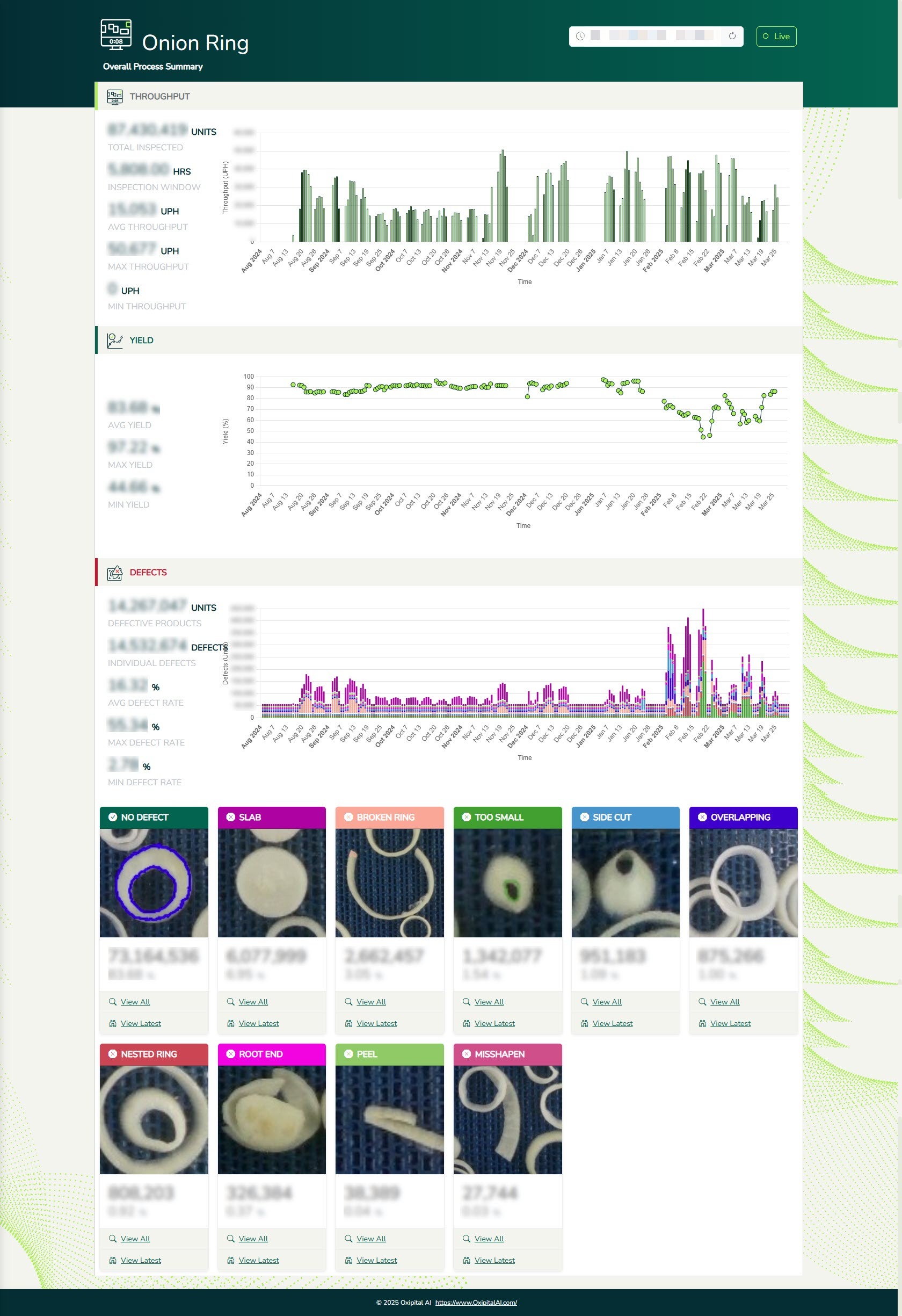
Oxipital AI does not shy away from challenging inspection problems. We turn around models quickly, support full deployment and testing, and work alongside manufacturers to prove value in real production environments. This deployment goes beyond inspection. The system identifies 10+ defect classifications and seamlessly integrates with multiple robots that automatically bucketize products for either rework or scrap. Coordinating high-speed, multi-class defect detection with robotic picking represents a significant technical challenge, one that Oxipital AI and V-CORTX were uniquely positioned to solve.