
AI Defect Detection: How Visual AI Catches What Human Inspectors Miss
Human inspectors catch about 80% of defects. See how AI defect detection uses visual AI and synthetic data to catch what people miss on food lines.
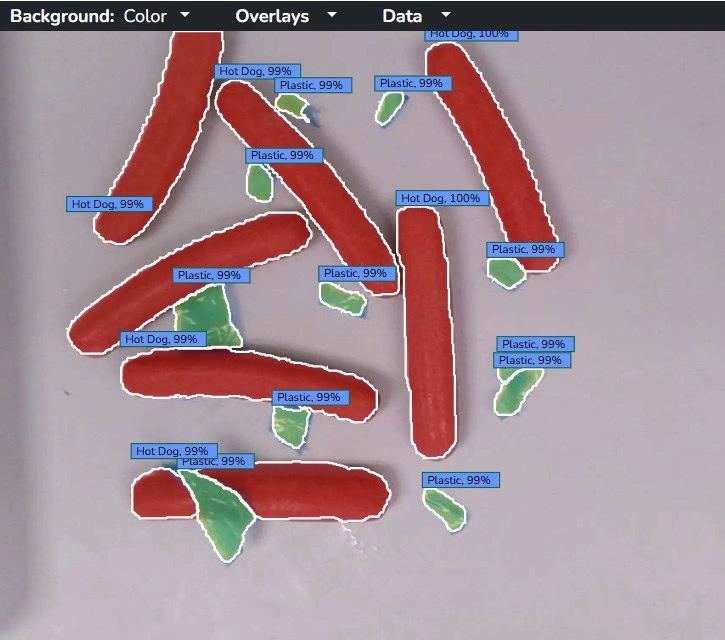
Key takeaways
- Trained human inspectors catch only about 80-85% of defects, and accuracy slips further with fatigue, subjective judgment and line speed.
- AI defect detection inspects every product against the same criteria at full line speed, with no fatigue and no drift between operators.
- It targets the defects people miss most: foreign material, bruising, coating gaps, missing components, and surface and packaging defects.
- Oxipital’s synthetic data removes the biggest setup barrier, so rare defects are covered from day one without collecting or labeling production images.
- A no-code Recipe Builder and Vision Model Manager let plant teams run and update inspection without a data science team.
Every day, manufacturers rely on people to inspect thousands, even millions, of products before they reach customers. AI defect detection is transforming that process by helping manufacturers automate visual inspection with greater speed, consistency, and accuracy than manual inspection alone.
The challenge isn’t that quality inspectors lack skill or experience. It’s that humans simply weren’t designed to stare at the same conveyor belt for eight or twelve hours searching for defects that may only appear once every several thousand products. Fatigue, repetitive tasks, inconsistent judgment, and increasing production speeds make it difficult for even the best inspectors to maintain perfect accuracy throughout an entire shift.
Research from Sandia National Laboratories found that trained human inspectors correctly identify defects only about 80–85% of the time.
For manufacturers producing hundreds of thousands of products every day, that remaining margin represents much more than missed defects. It can lead to costly recalls, unnecessary rework, excess labor, wasted product, customer complaints, and damage to brand reputation.
Modern AI visual inspection changes the equation. Unlike human inspectors, AI never loses concentration, becomes fatigued, or applies inconsistent judgment. Every product is evaluated using the same criteria, whether it’s the first product off the line or the millionth.
As manufacturers continue investing in automation, AI defect detection is becoming one of the most impactful technologies for improving food safety, product quality, operational efficiency, and profitability.
Why human inspectors miss defects
Manual inspection has long been the standard for quality assurance across manufacturing. Skilled operators are exceptionally good at identifying obvious problems, making judgment calls, and responding to unexpected production issues.
However, even experienced inspectors face limitations that technology simply doesn’t.
Fatigue reduces inspection accuracy
Most production environments require operators to inspect the same product repeatedly for hours at a time. Ironically, the better a production line performs, the harder the inspection task becomes.
When 99% of products are acceptable, inspectors spend hours watching identical products pass by with little need for action. Maintaining absolute concentration while waiting for the rare defective product is one of the most mentally demanding tasks in manufacturing.
Unlike people, AI doesn’t become distracted, lose focus, or experience decision fatigue. Every image receives the same level of attention regardless of production volume or shift duration.
Subjective decisions create inconsistency
Manual inspection also introduces variability between operators.
One inspector may classify a product as acceptable while another rejects it for rework. Those differences become even more common when inspecting subtle defects such as:
- Small tears or cracks
- Bruising or discoloration in raw produce
- Coating inconsistencies
- Foreign materials
- Surface blemishes
- Missing toppings or ingredients
- Packaging seal/ leak defects
Even with standardized work instructions, consistency is difficult when decisions rely on human interpretation.
AI evaluates every product using the same inspection criteria every time, reducing subjectivity across shifts, facilities, and production lines.
Production speed outpaces human capability
Today’s manufacturing lines move faster than ever.
Inspecting products at high speed while maintaining near-perfect accuracy is simply beyond what people can consistently achieve. As throughput increases, manufacturers often respond by adding more inspectors.
Unfortunately, adding labor rarely solves the problem.
Hiring dozens of additional operators increases annual labor costs, introduces training and turnover challenges, and still doesn’t eliminate inconsistency.
Many manufacturers find themselves spending millions of dollars each year on manual quality assurance while continuing to experience false rejects, missed defects, and production inefficiencies.
AI defect detection allows manufacturers to inspect every product at full production speed without increasing inspection labor.
What is AI defect detection?
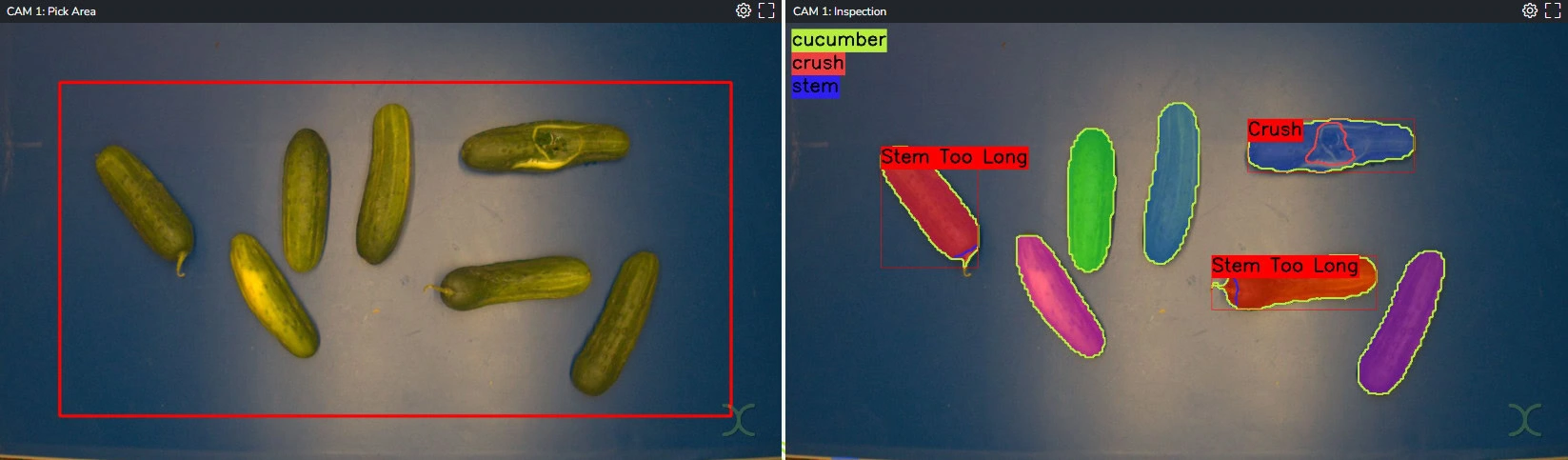
AI defect detection uses advanced Visual AI to automatically identify defects, classify products, and make inspection decisions in real time.
Instead of relying on human judgment, AI-powered inspection systems analyze high-resolution images captured by industrial cameras and determine whether a product should:
- Pass inspection
- Be sent for rework
- Be rejected as scrap
- Trigger additional downstream actions
All of this happens within milliseconds without slowing production.
Unlike traditional inspection methods that depend on operators visually identifying defects, AI continuously evaluates every product using trained models capable of recognizing subtle visual characteristics that are often difficult, or impossible, for humans to detect consistently.
This makes AI particularly effective in manufacturing environments where products naturally vary in:
- Shape
- Size
- Color
- Texture
- Orientation
- Surface finish
Rather than treating this variability as a problem, AI learns to distinguish acceptable variation from true defects.
The result is faster, more consistent inspection while reducing dependence on manual quality assurance. In practice, this is what AI quality control looks like on the line: every unit judged by the same criteria, every shift.
How visual AI catches what human inspectors miss
Manufacturing defects rarely announce themselves.
Many are subtle, inconsistent, and difficult to detect at production speed. Broken pieces hidden among similar-looking product. Slight bruising on raw produce before processing. Small foreign materials that blend into surrounding product. Tiny cracks, missing ingredients, coating inconsistencies, or surface defects that vary from one product to the next.
These are exactly the kinds of inspection challenges where AI outperforms manual inspection.
Instead of searching for one specific feature, Visual AI evaluates the entire product, learning the characteristics of both acceptable and defective products. This enables it to identify complex patterns that would otherwise require large manual inspection teams.
Because AI never tires, every product receives the same level of scrutiny regardless of shift length, staffing levels, or production volume.
For manufacturers, this leads to measurable improvements in:
- Defect detection accuracy
- Food safety
- Product consistency
- Throughput
- Labor efficiency
- Overall quality control
The impact extends beyond finding more defects. It creates a more predictable and repeatable manufacturing process where quality decisions are based on consistent data rather than human variability.
Common applications for AI defect detection
AI defect detection is now being deployed across virtually every segment of food manufacturing, helping producers automate inspections that were once considered too difficult or too labor-intensive. Many of these are surface defect detection tasks: cracks, discoloration and blemishes that vary from one product to the next.
Common applications include:
Foreign Material Detection
Identify foreign objects that blend naturally into surrounding product, improving food safety and reducing recall risk.
Raw Produce Inspection
Detect bruising, discoloration, cuts, blemishes, and other naturally occurring defects while distinguishing between product that can be reworked and product that should be discarded.
Protein Inspection
Inspect proteins for surface defects, contamination, trim quality, and other quality issues while maintaining line speed.
Prepared Foods
Identify broken components, coating inconsistencies, missing ingredients, product damage, and packaging defects across high-volume production lines.
Product Classification
Automatically sort products into multiple quality categories, including pass, rework, and scrap, to maximize yield while ensuring defective products never reach consumers.
Every application improves consistency while generating valuable production data that can be used to identify trends and continuously improve manufacturing performance.
Why Oxipital AI is different
Many AI vision solutions promise better inspection accuracy, but the biggest challenge often isn’t the AI itself, it’s everything required to train it.
Traditional machine vision inspection projects typically begin with months of collecting production images, manually labeling thousands of defects, and waiting for enough examples to build an accurate model. For manufacturers introducing new products or dealing with rare defects, this process can significantly delay deployment and increase project costs.
Oxipital AI removes that bottleneck.
At the core of V-CORTX is our patented Synthetic Data Generation technology, which enables AI models to be trained using highly realistic synthetic images instead of requiring manufacturers to build massive image libraries from production.
Rather than spending months collecting and labeling data, manufacturers can begin evaluating inspection models in days.
This approach is especially valuable when defects occur infrequently. Foreign materials, broken products, packaging failures, or other rare defects may only appear occasionally on a production line, making it difficult to collect enough real-world examples for traditional AI training. Synthetic data enables these scenarios to be represented from the start, accelerating deployment while improving model robustness.
The result is faster implementation, lower engineering effort, and a significantly shorter path to production.
No-code Recipe Builder
AI shouldn’t require a team of data scientists to operate.
That’s why V-CORTX includes a no-code Recipe Builder, allowing quality engineers and production teams to configure, manage, and update inspection applications without writing code or manually annotating images.
As products, recipes, or production requirements evolve, inspection models can be adjusted quickly through an intuitive interface, reducing downtime and making AI inspection accessible to the people who know the production process best.
Vision model manager
Manufacturing never stands still. New products are introduced, existing recipes change, and quality requirements continue to evolve.
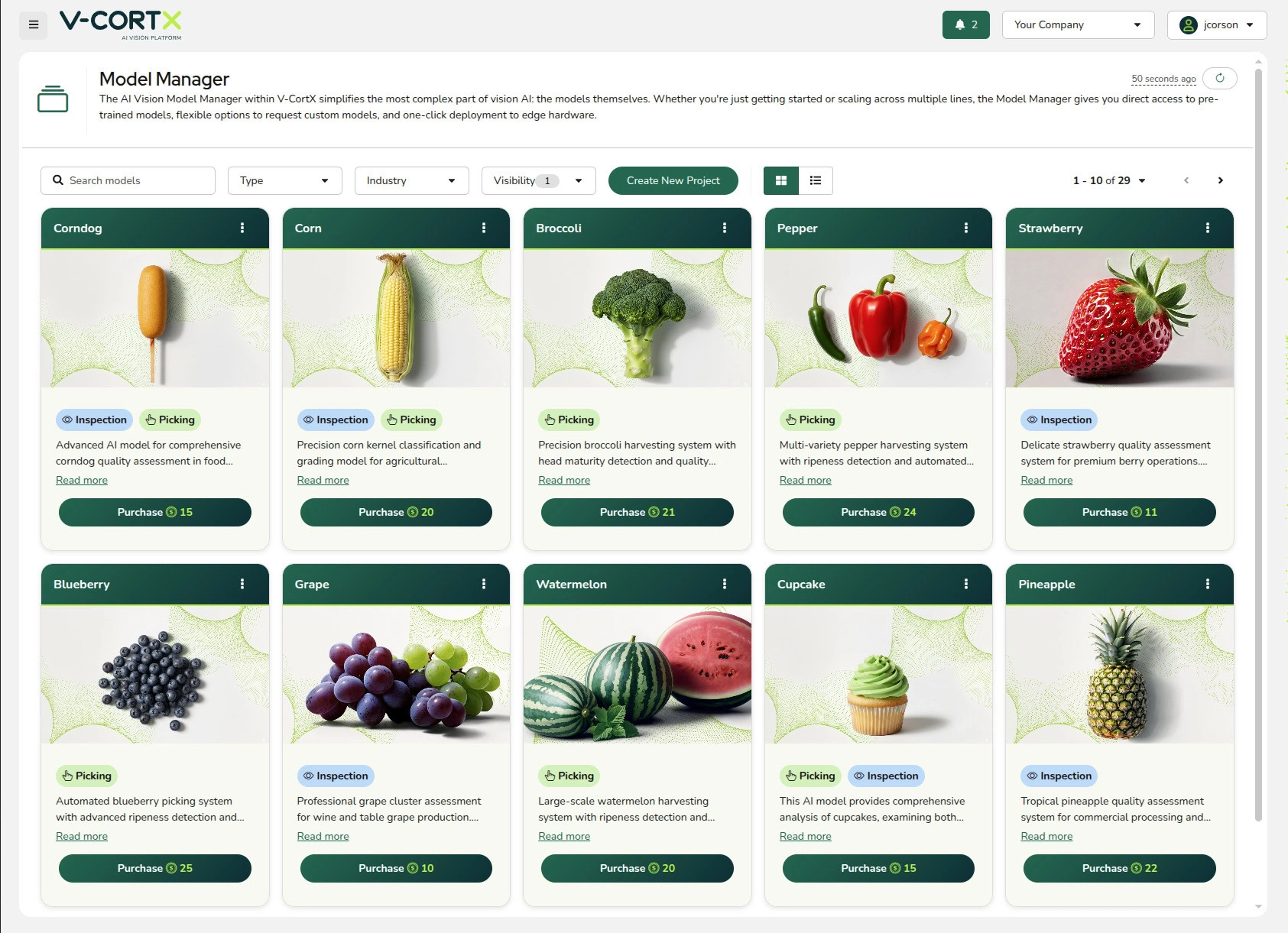
The Vision Model Manager provides a centralized way to deploy, manage, monitor, and update AI models across production lines and facilities.
Instead of rebuilding inspection systems every time production changes, manufacturers can continuously improve inspection performance while maintaining consistency across their operations.
More than inspection: production intelligence
Every inspection performed by V-CORTX generates valuable production data.
Through the built-in Analytics Dashboard, manufacturers gain visibility into defect trends, reject rates, recurring quality issues, shift performance, and historical inspection data.
Instead of simply identifying defective products, manufacturers can answer questions such as:
- Are defects increasing on one production line?
- Is a particular supplier contributing to higher reject rates?
- Which shifts experience the most quality issues?
- Are upstream process changes improving product quality?
These insights help manufacturers move beyond reactive quality control and toward continuous process improvement.
Inspection data becomes a powerful operational tool, not just a pass/fail decision.
AI defect detection in food manufacturing
Food manufacturing presents some of the most demanding inspection challenges in any industry.
Products naturally vary in shape, size, texture, moisture content, and color. Production lines operate at extremely high speeds, and even minor quality issues can have significant consequences for food safety, customer satisfaction, and brand reputation.
According to USDA Food Safety and Inspection Service recall data, foreign material remains one of the leading causes of food recalls in the United States.
At the same time, manufacturers continue facing labor shortages while consumers expect consistently high-quality products.
AI defect detection helps solve both challenges.
Today’s Visual AI inspection systems can automate applications involving:
- Foreign object detection
- Surface defect detection
- Broken products
- Missing ingredients or toppings
- Coating inconsistencies
- Packaging defects
- Raw produce grading and classification
- Protein inspection
- Product sorting for pass, rework, or scrap
Many of these applications have traditionally required large manual inspection teams because defects are subtle, inconsistent, or difficult to define using conventional inspection methods.
Manufacturers using AI defect detection can inspect every product with the same level of consistency while reducing dependence on manual labor. Used this way, automated defect detection becomes the backbone of AI quality control rather than a spot check.
The business impact of AI defect detection
The return on investment from AI inspection extends far beyond replacing manual inspection.
Manufacturers typically realize value across multiple areas of their operation simultaneously.
Reduced labor costs
Rather than adding dozens of inspectors to meet growing production demands, manufacturers can automate repetitive inspection tasks while allowing employees to focus on higher-value responsibilities such as process optimization and quality improvement.
Improved yield
Accurate classification helps recover good product that might otherwise be unnecessarily discarded while ensuring defective products never reach customers.
Better food safety
Earlier detection of foreign materials, contamination, damaged products, and other quality issues reduces the likelihood of recalls while strengthening consumer confidence.
Lower cost of poor quality
According to the Institute of Industrial & Systems Engineers (IISE), the Cost of Poor Quality (COPQ) often ranges between 5% and 35% of annual sales, with many manufacturers averaging approximately 15%.
Reducing scrap, rework, warranty claims, customer complaints, and production inefficiencies can deliver significant financial returns.
Continuous operational improvement
Inspection data provides manufacturers with a clearer understanding of where defects originate, enabling teams to address root causes rather than repeatedly treating symptoms.
For many organizations, AI inspection becomes a catalyst for broader operational excellence initiatives.
The future of quality inspection
Manufacturing continues to evolve.
Production lines are becoming faster, labor remains difficult to secure, and expectations around food safety and product quality continue to increase.
Quality teams need tools that can keep pace with those demands.
AI defect detection enables manufacturers to inspect every product consistently while reducing manual inspection, improving yield, strengthening food safety, and providing operational insights that extend well beyond quality assurance.
With V-CORTX, manufacturers gain more than an inspection system. They gain a Visual AI platform that combines patented Synthetic Data Generation, a no-code Recipe Builder, centralized Vision Model Management, and advanced production analytics to help solve some of manufacturing’s most difficult inspection challenges.
Whether you’re inspecting proteins, produce, prepared foods, baked goods, frozen products, or packaged consumer goods, AI defect detection provides a scalable path toward better quality, stronger operational performance, and faster return on investment.
Ready to see AI defect detection in action?
Every production line has unique quality challenges.
Whether your goal is to improve food safety, protect brand reputation, tackle complex raw produce inspection, reduce manual inspection, increase yield, or automate a complex inspection process, Oxipital AI can help you evaluate how Visual AI fits into your operation.
Explore our Visual AI Inspection Systems, or contact our team to learn how V-CORTX can help automate the inspections your operators struggle to perform consistently.
AI Defect Detection Frequently Asked Questions
What is AI defect detection?
AI defect detection uses artificial intelligence and computer vision to automatically identify defects, classify products, and make quality decisions during production without relying on manual inspection.
How is AI defect detection different from manual inspection?
Manual inspection depends on human judgment, which can vary due to fatigue, distraction, or experience. AI evaluates every product using the same criteria, delivering consistent inspection results throughout every production shift.
What types of defects can AI detect?
AI can identify foreign materials, bruising, discoloration, cracks, coating inconsistencies, broken components, missing ingredients, packaging defects, contamination, and many other visual defects that are difficult to detect consistently by eye.
Does AI replace quality inspectors?
No. AI automates repetitive visual inspection tasks, allowing quality teams to spend more time improving processes, investigating root causes, and driving operational improvements.
How quickly can AI inspection be deployed?
Using Oxipital AI’s patented Synthetic Data Generation technology, manufacturers can begin evaluating production-ready inspection models in days rather than spending months collecting and labeling production images.
Which industries benefit from AI defect detection?
AI defect detection is widely used across food processing, proteins, produce, prepared foods, frozen foods, bakery due to the variability in production. However packaging, pharmaceuticals, automotive, consumer goods, and other manufacturing industries where quality and consistency are critical can also benefit.