
AI vs. Traditional Machine Vision: Which Inspection Approach Is Right for Your Manufacturing Operation?
Traditional machine vision has served manufacturers well for years, but today’s production environments demand more. As product variability, food safety requirements, and labor challenges increase, AI Vision offers a more accurate, scalable, and adaptable approach to automated inspection. This article compares both technologies and explains why manufacturers are adopting AI-powered inspection to improve quality, reduce…

Manufacturers today face increasing pressure to improve quality, reduce labor dependency, prevent recalls, and maintain profitability. At the same time, products are becoming more complex, production lines are running faster, and customer expectations continue to rise.
For years, traditional machine vision systems have helped automate inspection tasks. But many manufacturers are discovering that applications involving natural product variation, subtle defects, and food safety risks often push these systems beyond their limits.
As a result, more companies are evaluating AI Vision as the next evolution of automated inspection.
So, what’s the difference between traditional machine vision and AI Vision, and why are food manufacturers increasingly making the switch?
Traditional Machine Vision vs. AI Vision
Factor | Traditional Machine Vision | AI Vision (OX2) |
| Inspection Method | Uses predefined rules, thresholds, edges, and measurements | Learns patterns from real-world examples |
| Product Variability | Struggles with natural variation | Handles variability effectively |
| Defect Detection | Best for simple, well-defined defects | Excels at subtle, complex, and inconsistent defects |
False Rejects | Often increase as variation increases | Reduced with ability to handle variability |
| Adaptability | Requires reprogramming and retuning | Adapts to new products and changing conditions |
Manual Inspection Reduction | Limited in complex applications | Significantly reduces labor dependency |
| Food Safety Applications | Challenging for subtle contamination or product defects | Well-suited for food safety and quality inspection |
| Scalability | Rules must be recreated for new applications | Models can be deployed across multiple applications |
| ROI Potential | Often limited to simple inspections | Labor, yield, quality, and recall-prevention benefits |
For simple applications such as barcode reading, label verification, or part presence checks, traditional machine vision remains effective.
But modern manufacturing environments often demand much more due to product, presentation, and environmental variability.
Where Traditional Machine Vision Falls Short
Many of today’s inspection challenges involve products that simply don’t behave consistently.
Examples include:
- Raw produce with natural variability
- Coated or battered products
- Foreign material detection
- Food safety inspection
- Product classification across multiple defect categories
- Inspection of products with varying shapes, colors, and textures
In these situations, engineers can spend weeks creating and maintaining rule sets that still struggle to account for real-world production conditions. Every lighting change, process adjustment, or product variation can require additional tuning and support.
For manufacturers, this often leads to:
- Increased engineering costs
- Continued reliance on manual inspection
- Higher false reject rates
- Missed defects
- Reduced confidence in inspection results
Why AI Vision Is Different
AI Vision systems don’t rely on engineers defining every possible defect condition.
Instead, they learn what good and bad product looks like and make decisions based on patterns that are often impossible to define manually at line speeds.

This makes AI particularly effective in applications involving:
- Subtle visual defects
- Natural product variation
- High-speed production lines
- Multiple defect classifications
- Complex food safety challenges
The result is more consistent inspection performance, reduced waste, and better quality outcomes.
Just as importantly, AI eliminates much of the subjectivity that exists in manual inspection. Products are evaluated using the same criteria every time, regardless of shift, operator experience, or production conditions.
Where OX2 Fits In
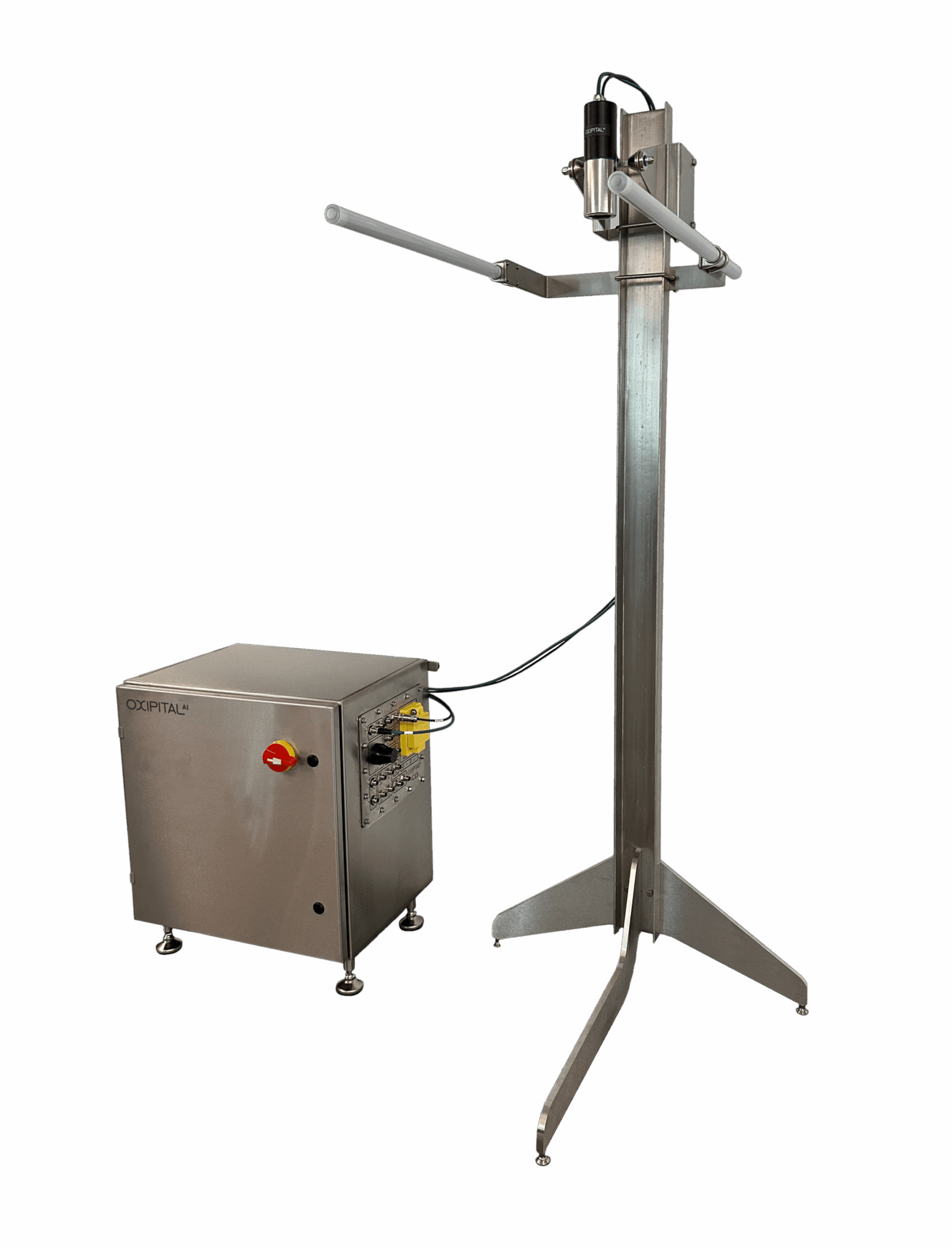
OX2 is Oxipital AI’s industrial AI Vision system designed specifically for food and manufacturing environments.
Unlike traditional machine vision products that depend on extensive rule creation, OX2 uses advanced AI to automate inspection tasks that have historically required large manual inspection teams.
Manufacturers use OX2 to:
- Detect defects at line speed
- Identify foreign material and contamination risks
- Improve food safety programs
- Reduce labor dependency
- Increase yield through more accurate classification
- Minimize false rejects
- Reduce recall risk
- Improve overall product quality
- Better understand their operation before deploying automation
Most importantly, OX2 helps manufacturers solve applications that many traditional vision systems struggle to automate and it does so without requiring changes to the existing production line.
Beyond Inspection: A Foundation for Smarter Automation
For many manufacturers, inspection is only the beginning.
The production data generated by OX2 provides valuable insight into quality trends, process variability, and operational performance. This visibility helps teams make better decisions, identify root causes, and uncover opportunities for continuous improvement.
It also creates a foundation for future automation initiatives such as robotic picking, robotic guidance, and vision-guided robotics.
This is why Oxipital AI advocates a simple approach: Visual Inspection First. Automation Next.
Before deploying robotics, manufacturers need reliable data and visibility into their production processes. OX2 provides that foundation.
The Business Impact
Manufacturers deploying AI Vision are seeing benefits that extend far beyond defect detection.

Common outcomes include:
- Lower labor costs
- Reduced manual inspection requirements
- Improved yield
- Less rework and waste
- Stronger food safety performance
- Reduced recall risk
- More consistent quality
- Faster root-cause analysis
- Better customer satisfaction
These improvements often create ROI in months- not years.
Final Takeaway
Manufacturers deploying AI Vision are seeing benefits that extend far beyond defect detection.
Traditional machine vision still has a place in highly controlled applications. But as manufacturing becomes more complex, AI Vision is proving to be a more scalable, adaptable, and effective solution.
For manufacturers looking to improve quality, reduce labor dependency, and strengthen food safety programs, OX2 delivers the benefits of AI-powered inspection without the limitations of traditional rule-based systems.
Because in modern manufacturing, quality isn’t just about finding defects.
It’s about protecting your brand, improving profitability, and building a smarter operation for the future.