
Machine Vision Solutions Buyer’s Guide: How to Choose the Right Platform
How to choose a machine vision system: an 8-point rubric for accuracy, retrofit, hardware and cost, plus where AI vision deploys in days not months.

Key takeaways
- A machine vision solution consists of cameras, industrial computers, plus software, increasingly AI, that inspect product or guide robots automatically on a production line.
- Score every platform on one rubric: accuracy on your defects, deployment effort, retrofit fit, hardware for the environment, real-time criteria control, scalability, model ownership and total cost of ownership.
- AI vision built on pre-trained models and proprietary synthetic data generation can deploy in days, not months, because it skips the image collection and labeling that rules-based systems demand.
- Ask for a proof of feasibility or pilot on your own product instead of trusting quoted accuracy numbers. The result that matters is the one measured on your line.
A machine vision solution earns its place on a production line by doing one job well: seeing what a skilled human inspector can catch, at line speed, every shift, without getting tired. On a real line that job is harder than a demo suggests. Product varies. Lighting shifts. A frozen pizza is never topped the same way twice, and a poultry part that looks clean from one angle hides a defect from another. The trade group A3 (Association for Advancing Automation) treats machine vision as imaging plus analysis that guides an action in automation. On a food line, that action could be human lead process changes, automated defect removal, or even robotic sortation.. So the system has to hold up against variability, fit the equipment you already run and give your team something they can operate without a data scientist on call. This guide gives you a rubric for evaluating machine vision systems and a plain read on where AI has changed the math.
The evaluation rubric
Use the same rubric for every machine vision inspection platform you shortlist. Buying committees get into trouble when they compare vendors on whatever each vendor chose to highlight. Fix the criteria first, then make every platform answer the same questions. Eight of them separate a system that still works in year two from one that stalls after the demo.
- Accuracy on your defects. Vendors quote accuracy on their samples, not yours. Ask what the system does on your product, your defects and your line conditions. A number from someone else’s line tells you almost nothing about your own.
- Ease of deployment: no-code versus DIY. Some systems need engineers to write inspection rules or data scientists to label images. Others ship pre-trained and are configured through software. That difference is weeks of specialist time against days.
- Real-time criteria control. Most automation is set and forget: you configure it once and leave it running. Food does not work that way. A crop, a harvest, or a seasonal change can shift what counts as a defect from one week to the next, so the platform has to let your team adjust inspection criteria in real time, without a specialist or a requote. Ask whether you can change the standard yourself, on the line, the day it changes.
- Retrofit to existing lines. The system should fit the conveyors, cameras and cells you already run. Rebuilding a line around a camera is a cost that rarely shows up in the quote.
- Hardware for the environment. Food plants wash down. Inspection hardware has to survive water and caustic cleaning. Look for food-grade materials and an IP69K rating, not an office-grade camera in a housing.
- Scalability. Copying a working setup from one line to the next, and one plant to the next, should be a configuration step rather than a fresh project every time.
- Maintenance and who owns the models. When product changes, some systems require a model update. Ask whether your team can can make meaningful changes in the field.
- Total cost of ownership. The camera price is the small number. The real cost is integration, labeling, tuning, downtime and the specialist hours it takes to keep the system running. A cheaper platform that needs a data scientist on retainer for regular mode retraining is not cheaper..
Score each platform the same way and the shortlist gets honest fast. A vendor that welcomes hard questions on maintenance and retrofit tends to be a vendor whose system holds up once the sales engineer goes home.
AI vs traditional machine vision
Traditional, rules-based machine vision works by an engineer writing explicit instructions: measure this dimension, confirm that this region falls inside a color band. It is precise on parts that look the same every time. It struggles with natural variation, which is most of what a food line produces, and retooling for a new product means rewriting the rules.
AI vision learns the object instead of the rule. The V-CORTX platform uses pre-trained object models and proprietary synthetic data generation, so it does not ask you to collect and label thousands of product images first. That matters in practice. The slowest part of a conventional AI vision project is usually the dataset: photographing enough good and defective product in a production environment, then labeling every image by hand before a model can learn anything. Synthetic data generation removes that phase. No code. No annotation. No machine learning expertise to deploy. The models arrive trained, and the AI Vision Model Manager is where your team keeps them current as product and packaging change. Those models start from a high-resolution 3D scan of your actual product, not a hand-labeled photo library or generative-AI images, so they learn your product’s real shape, color, and natural variation.
This is also where a food-first platform reads differently from a general-purpose one. A generalist vision tool can inspect almost anything once someone teaches it, which puts the teaching burden on you. A platform built for food arrives already fluent in the product you make, so the buying question shifts from how long will training take to how fast can we validate this on our line.
Both approaches use inputs from cameras. The difference is how they decide, and how much specialist effort that decision costs you across the life of the line. Because there is no image-collection phase to work through, an AI line can move from kickoff to inspecting in days rather than months.
Deployment, retrofit and maintenance
Deployment speed means little if the platform cannot fit the line you already run. Oxipital’s visual AI inspection systems are built to retrofit existing processes and equipment, so you add inspection to a line instead of rebuilding it around a camera. Ask a candidate vendor to walk your actual line, not a reference layout, and show where their hardware mounts and how it ties into your controls. The platform works with 3D Vision and RGB inputs, which matters when a defect reads as a shape in three dimensions rather than a color in two. A missing chunk on a formed product often only shows up in depth, and a burnt edge or a label error shows up in color, so a system that handles both covers more of what a real line throws at it.
Maintenance is where many vision projects quietly fail. Product changes. Seasons change the produce. A new SKU shows up on Monday. If every one of those changes means a call to the vendor, the line waits. So ask who owns the models after go-live. With Recipe Builder, your team configures inspection recipes for each product through human-readable rules, which lets a line lead adjust a setup without writing code. Ownership on your side is what keeps a system useful long after the launch.
Hardware and total cost of ownership
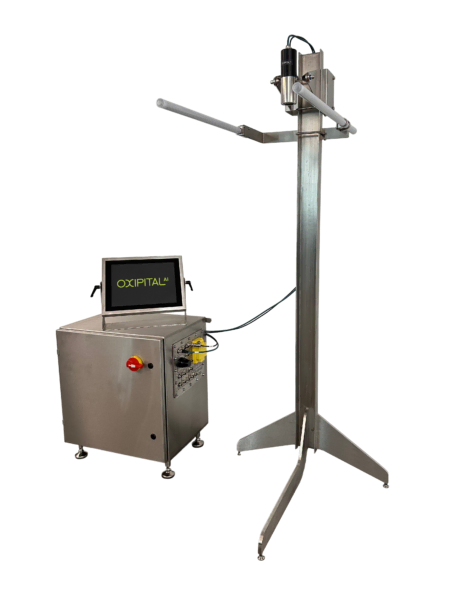
Software makes the decision, but hardware has to survive the plant. Oxipital’s OX2 inspection hardware is made with food-grade materials in an IP69K package and integrates ultra-high-performance cameras, Edge-AI computers and application-specific lighting for the harshest production environments. That specification is not a detail. A camera that cannot take a wash-down becomes downtime. The models are also trained to adapt to your plant’s own lighting, so inspection stays reliable as conditions shift across shifts and lines.
On total cost of ownership, be skeptical of quoted numbers. Accuracy, throughput and defect rates from a vendor’s own lab describe the vendor’s product, not yours. Even an impressive figure was measured on someone else’s product under someone else’s lighting, at a speed that may not be your speed. The honest test is a pilot on your own product, your own defects and your own line. Demand one. A system that performs on your line is worth more than a spec sheet that performs on a slide, and a pilot is the fastest way to compare two platforms on the accuracy number that actually counts: the one measured on your product. It also surfaces the costs a quote hides, from integration effort to how much of your team’s time the system needs each week once it is live.
Frequently asked questions
A machine vision solution consists of cameras, industrial compute, and software, increasingly AI, that inspect product or guide equipment automatically on a production line. It does the seeing a person would do, consistently and at line speed.
Score every platform on the same rubric: accuracy on your defects, deployment, retrofit, hardware, scalability and cost. Then run a pilot on your own product before you commit to anything.
Traditional machine vision follows rules an engineer writes and does best on parts that look identical every time. AI vision uses pre-trained and synthetic-data models, so it needs no rule-writing or image labeling, deploys faster and adapts to natural variation in the product.
Oxipital states days, not months, using pre-trained object models rather than collected and labeled images. Treat that as the target to validate on your own line during a pilot.
See how V-CORTX fits
You do not need to trust a vendor’s numbers to make this call. You need a rubric and a pilot. See how the V-CORTX platform meets each of these criteria, then ask for a pilot on your own product through Oxipital’s visual AI inspection systems and measure the result on your line. To learn how the company works with system integrators and OEMs, read more about Oxipital AI.