
AI Vision vs. Rules-Based Vision Systems: Why Food Applications Need a Different Approach
Rules-based vision wins on stable parts; AI vision handles food’s natural variability. Compare both approaches and match the right tool to the task.
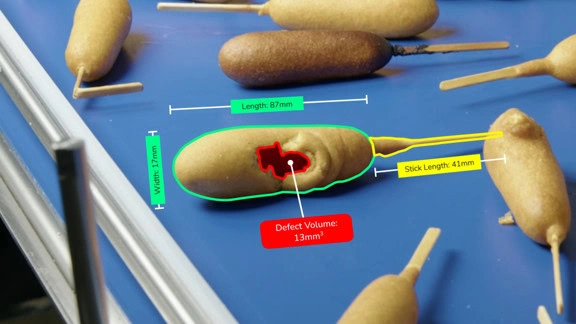
Key takeaways
- Rules-based vision uses fixed thresholds and is the right, cheaper choice for stable geometric parts and presence-absence checks.
- AI machine vision learns from examples and handles the natural variability in shape and size that defines food products.
- Food breaks rules-based systems because a fixed tolerance cannot follow a product that changes batch to batch.
- The historic blocker was never accuracy; it was the image-collection and labeling burden that stalls every project.
- Synthetic data plus a no-code builder removes that burden, so an integrator, a manufacturer, or a machine builder can deploy AI vision in days without a data-science team.
- Most food lines run both approaches. Match the tool to the task rather than forcing one across the line.
Every manufacturer, machine builder, and integrator specifying a vision system for a food line faces the same fork in the road. Do you reach for a rules-based machine vision system, the deterministic tooling that has run factory inspection for decades, or an AI machine vision system that learns what a defect looks like from examples. The honest answer is that both are right, just for different jobs, and picking wrong is expensive either way. Rules-based machine vision systems are cheaper, faster and easier to validate on the tasks they suit, and no amount of AI marketing changes that. What changes the calculus is the product itself. Food does not hold still, and that is where they part ways.
Rules-based, or traditional, machine vision explained honestly
Rules-based machine vision runs on deterministic logic. An engineer defines the features that matter, sets fixed thresholds, and the system passes or fails each part against that logic. Measure this dimension, check that this edge falls inside a tolerance, confirm a label is present in a fixed window. The appeal is real and worth stating plainly. It is fast, it is repeatable, it is inexpensive to run, and it is easy to validate because the pass or fail criteria are explicit. For a stable, well-presented, geometric part, it is hard to beat, and for many gauging and presence-absence checks it remains the correct call. There is a compliance angle too. Because every decision traces back to an explicit rule, a rules-based system is straightforward to document and validate, which matters on an audited line. Do not give that up lightly when the task genuinely suits it.
The limit shows up the moment the product stops cooperating. Because the logic is rigid, a rules-based system only knows what it was told to measure. A threshold that separates good from bad on Monday’s product can start failing good parts on Tuesday’s, not because quality dropped but because the product looks a little different. Tighten the threshold to catch a new defect and you start rejecting acceptable product. Loosen it to stop the false rejects and you miss the defect. On a fixtured metal part that trade-off rarely bites. On natural product it is a daily fight. If you are weighing this against a learning-based approach, our overview of visual AI inspection systems lays out the alternative.
AI machine vision and deep learning explained honestly
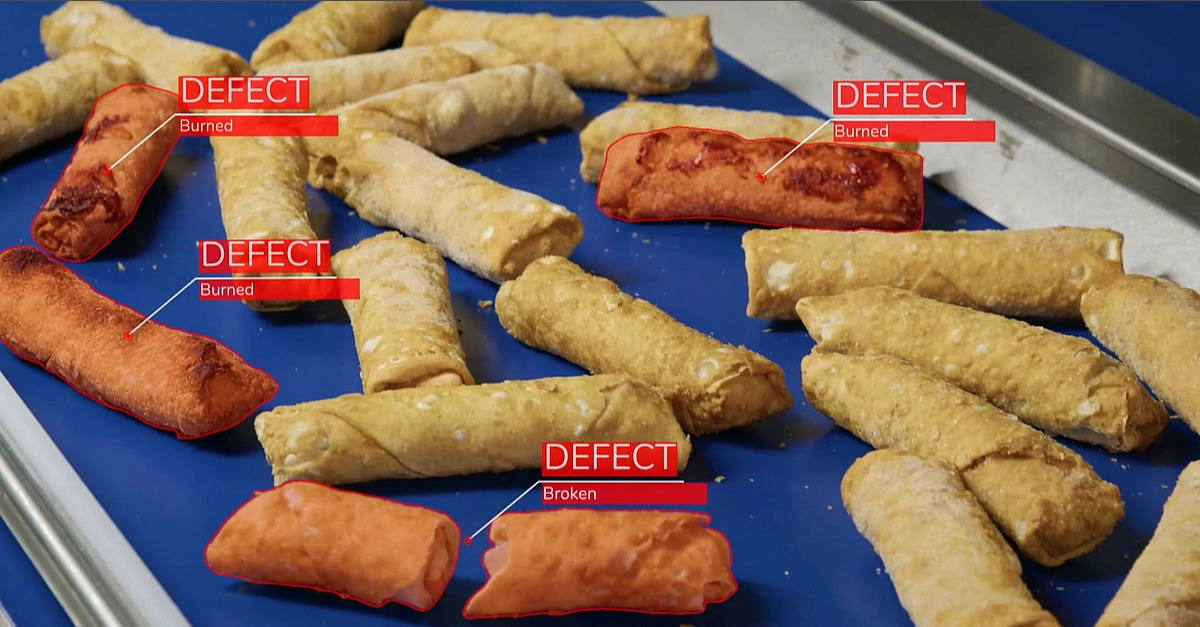
AI machine vision takes the opposite path. Instead of an engineer defining every feature, a deep learning machine vision model learns the difference between good and bad from labeled examples, the way a seasoned inspector develops an eye over thousands of parts. Once trained, it generalizes to variation it has not seen exactly before, which is the whole reason it handles natural product where rules struggle.
The capability is not marketing. A peer-reviewed deep-learning defect study reached 75.8 percent mean average precision across a range of surface defect types that vary in shape and appearance. That work was on aluminum surfaces rather than food, so read it as evidence that deep learning handles variable defects in general, not as a food-line number. The direction of travel is the same across the market, with the machine vision market projected to reach $41.74 billion by 2030 at 13 percent annual growth. The growth is concentrated in the software, the part that decides what the camera is looking at.
There has always been a catch, and it is the honest counterweight to all of the above. Historically, deep learning needed you to collect and label thousands of images and bring in data-science skill to train and tune the model. That is the real cost integrators run into, and it is the subject of the next two sections. Managing those trained models over time is its own job, which is why platforms build a dedicated AI Vision Model Manager for it.
Why food breaks rules-based systems
Here is the core of the argument. Natural and prepared food products vary in shape, size and orientation in ways that stamped or molded parts simply do not. A rules-based tolerance is a fixed line drawn through a moving cloud of acceptable product, so it is always either too tight or too loose.
Make it concrete. A foreign object on a pizza line can appear anywhere, at any size, against a busy background of cheese and toppings, which is precisely the kind of open-ended defect detection that fixed rules cannot enumerate in advance. Seal and fill variation on a pouch or tray shifts with product settle and line speed, so a rigid inspection window flags good packs and passes marginal ones. Pick-and-place on irregular product means the robot has to find and grip an item that never presents the same way twice, which a geometric rule cannot describe. In each case the task is not a measurement, it is a judgment across variation, and that is what learning-based vision is built for. The same object understanding drives vision-guided pick-and-place robotics as well as inspection.
Defect detection is the sharpest case. A rules-based system can only look for the defects someone described to it in advance, against thresholds set ahead of time. But the defects that matter most on a food line are often the ones nobody predicted: an odd char pattern, a topping that slid, a contaminant with no fixed size or shape. A model trained on what good product looks like can flag the thing that is simply wrong, even when it has never seen that exact failure before. That is the difference between checking a spec and exercising judgment, and it is why food quality teams reach for learning-based defect detection when the failure modes will not sit still.
The classic AI blocker: data, labeling and expertise
For an integrator, the knock on AI vision was never the accuracy. It was the project. Traditional deep learning makes you collect a large image set, label every example by hand, and either hire or borrow data-science skill to train, evaluate and iterate the model. Then you do a chunk of it again when the product or the defect set changes.
That is not a footnote in the timeline; it is most of it. IBM’s research puts data preparation at 60 to 80 percent of total AI project time. Even leading tools carry this load, with Cognex VisionPro Deep Learning training from annotated and labeled images per its own documentation. For an OEM or systems integrator that data burden is a margin and schedule problem. Every deployment stalls on image collection, every new SKU reopens the labeling task, and the payback slips.
The timing sharpens it. The manufacturing skills gap is set to leave 2.1 million US jobs unfilled by 2030, so the plants that most need automated inspection are often the ones least able to spare a data-science team to stand it up. A system an integrator can deploy without that team is not a nice-to-have; it is the only version that actually ships. Solve the data problem and AI vision stops being a research project and starts being something you can quote with confidence.
Oxipital’s answer: synthetic data plus no-code deployment
This is where Oxipital’s approach changes the integrator’s math. Its AI machine vision models are trained on proprietary synthetic data, so there is no image collection and no manual labeling standing between you and a working model, and the cold-start problem largely goes away. The application logic is then built in a no-code Recipe Builder, so an integrator configures and adapts an inspection without a data-science team and without writing code. Because the logic lives in the recipe and is decoupled from the model, you can adjust the application without retraining the vision model, which keeps iteration fast and maintenance low.
For a partner, that shortens the path from quote to deployed line from months to days and takes the data-science dependency off the critical path. It is also the basis of Oxipital’s partner program for machine builders and integrators, which adds priority access to applications engineers and remote monitoring. See the V-CORTX no-code AI machine vision platform and the no-code Recipe Builder for how the pieces fit. None of this makes rules-based vision obsolete. It removes the specific reason integrators used to avoid AI on food lines.
Side-by-side comparison
| Factor | Rules-based / traditional machine vision | AI / deep-learning machine vision |
| How it decides | Fixed thresholds and engineer-defined features | Learns good and bad from examples |
| Data needed | None to train, just configuration | Labeled images, historically thousands. With synthetic data, none to collect or label |
| Handles variability | Poorly, brittle when product changes | Well, generalizes across natural variation |
| Deployment effort | Low for simple stable tasks | Historically high, low with synthetic data plus no-code |
| Maintenance | Re-tune thresholds when product shifts | Update the recipe, no retraining when logic changes |
| Best-fit applications | Gauging, presence and absence, barcode reading, stable geometric parts | Cosmetic and surface defect detection, foreign objects, natural product, variable orientation |
Read the table as guidance, not a verdict. The right-hand column earns its place on variable product. The left-hand column still wins outright on the simple, stable cases in the bottom row.
When to use which
Choosing between them is not ideological, it is about the part in front of the camera. Reach for a rules-based machine vision system when the product is stable and well-presented and the task is a measurement: gauging a dimension, confirming presence or absence, reading a code, checking a fixtured assembly. These are the cases where deterministic logic is cheaper, faster to validate and entirely sufficient, and adding AI would be over-engineering.
Reach for AI machine vision when the product varies and the judgment is visual: cosmetic and surface defects, foreign material, completeness on a mixed or natural product, or picking an item that never presents the same way twice. Most food lines are a mix, which is why machine vision systems on a real plant floor often run both, deterministic checks where they fit and learning-based inspection where variation would break a rule. The skill is matching the tool to the task rather than forcing a single approach across the whole line. A simple test helps. If you can write the pass or fail rule as a fixed measurement, rules-based will likely handle it well. If the rule keeps needing exceptions for product that is still perfectly good, that is the signal to bring in AI.
AI Vision and Rules-Based Vision Systems Frequently Asked Questions
Rules-based vision uses fixed, deterministic thresholds and engineer-defined geometric rules to pass or fail a part. AI vision learns pass and fail patterns from examples, so it handles products that vary in shape, color, and size where fixed rules break.
Not universally. Rules-based vision still wins on stable geometric parts, gauging and simple presence-absence checks, where it is cheaper and easier to validate. AI wins where the product varies, like natural food products, so the honest answer is that it depends on the application.
Traditionally, yes, and that image-collection and labeling burden has been the main blocker for integrators. Synthetic training data removes the need to collect and label images and solves the cold-start problem, which is how deployment shortens from months to days.
AI vision generally handles the shape and size variability of natural food products better than rules-based systems, especially for cosmetic defects and foreign material. For a stable, fixtured measurement on a food line, a rules-based check can still be the simpler choice.