
Industrial AI in Manufacturing: How AI Vision Is Transforming Production Lines
AI vision inspection retrofits existing lines in days, not months. Learn where AI beats traditional machine vision in manufacturing quality control.
Key takeaways
- Industrial AI covers predictive maintenance, process optimization, quality inspection and robotic guidance, but vision-based inspection is the fastest to deploy and prove.
- Rules-based machine vision still wins on stable, geometric parts. AI vision earns its place where product, presentation, or environments vary, which is the norm in food and CPG.
- The real barrier to AI vision has never been accuracy, it is the data: collecting and labeling thousands of images before anything works.
- Synthetic training data and no-code setup remove that barrier, cutting deployment from months to days on existing lines.
- Start with one inspection on one line, measure it against your current process, then scale what works.
Walk any plant floor, and you will find automation almost everywhere. Robots weld, conveyor sort, fillers dose to the gram. Then you reach final inspection, and a person is squinting at the product as it goes by. That gap is the honest starting point for any conversation about AI in manufacturing. The technology has reached most of the line. Judgment about quality has been the hard part to hand over.
The pressure to close that gap is real. McKinsey’s analysis of the economic potential of generative AI puts the annual value in play at $2.6 trillion to $4.4 trillion. At the same time the people are getting harder to find, with the manufacturing skills gap set to leave 2.1 million jobs unfilled by 2030 at a cost of as much as $1 trillion. So the money is real, and the labor is short. The useful question is not whether to adopt industrial AI but where to start. This piece makes a plain argument: of all the AI a plant could deploy, vision on the line pays back fastest, because inspection is a discrete, measurable task you can pilot on one line and prove in weeks.
What AI in manufacturing and smart manufacturing actually mean
Start with the words, because they get used loosely. Industrial AI is the application of machine learning to the physical work of making things: inspecting products, guiding robots, predicting failures, optimizing processes. Smart manufacturing is the broader idea that lies within Industry 4.0, where machines, sensors, and software share data so the line can be monitored and adjusted in near real time. One is a set of techniques. The other is the connected environment in which those techniques run.
In practice, industrial AI on a production line tends to show up in the same handful of areas. Predictive maintenance watches equipment for the signature of a coming failure, and McKinsey’s operations research shows AI-driven programs can cut maintenance costs by 10 to 40 percent while reducing unplanned downtime. Process optimization tunes settings across a run to hold quality and yield. Quality inspection checks whether each unit is good. And robotic guidance lets a machine see what it is picking or placing.
These are not equal in how fast they return anything. Something like predictive maintenance is valuable but slow, needing historical data, model tuning and buy-in across a plant before the savings show. Process optimization is closer to inspection than it first looks: once a vision system is checking every unit, the data it gathers becomes the raw material for optimizing the line, either immediately or through planned automation projects later. Quality inspection is different again, and that difference is the whole point of the next section. If you want a fuller grounding in the underlying technology first, our guide to visual AI inspection systems covers the fundamentals.
Why vision is where AI pays off fastest on the line
Here is the case for starting with vision. Inspection is a bounded problem. You are asking a single question: Is this unit acceptable, and can you measure the answer against what a trained person would say? That means you can pilot it on a single line, compare it to your current process, and know within weeks whether it works. Compare that to a multi-year process-optimization program and the appeal of computer vision in manufacturing becomes obvious. It is the AI project with the shortest path from install to proof.
The market has noticed. Industry analysts expect the machine vision market to reach $23.63 billion by 2030, growing at 8.3 percent a year, with AI-based software the fastest-growing part of it. The hardware has been on lines for decades. The part that is growing is the intelligence layer, the software that decides what the camera is looking at.
That is the shift that matters. For most of its history, vision on a line meant a camera plus a set of hand-written rules. It worked, within limits. What changed is that the software can now learn what good and bad look like from examples, which opens up the inspections that rules could never handle well. The next section draws that line clearly.
AI vision vs traditional rules-based machine vision
Traditional machine vision is rules-based. An engineer defines the features that matter, measures against fixed thresholds, and the system passes or fails each unit on that logic. For a stable, well-fitted part, this is excellent. It is fast, it is cheap, it is repeatable and it is easy to validate. If you are checking whether a cap is present or measuring a dimension that does not move, a rules-based system is still the right tool and you should use one.
The trouble starts when the product varies. Rules are brittle by nature. A threshold tuned for Monday’s batch can reject Tuesday’s, not because Tuesday is worse but because it is different. Natural products vary in shape, color, size and position in ways that stamped metal parts do not, and that is where rules-based logic spends its engineering budget and still struggles.
AI vision takes the other approach. Rather than defining features by hand, it learns them from examples, the way an experienced inspector builds an eye for defects over time. Trade press has been documenting the shift for years. An Automation World analysis of deep-learning inspection describes the change plainly: rather than defining an image feature by shape, size or location, deep learning machine vision tools are “trained by example.” Learning from examples is what lets AI vision hold up against variability at full line speed.
Neither approach wins everywhere, and any honest source will say so. The short version is that rules-based systems suit the stable and simple, while AI vision earns its place on the variable and visual. Where each one belongs, and how synthetic data changes the economics, comes down to the catch that stalls most AI-vision projects, the training data, which the barrier section below takes on directly. Managing those trained models is its own discipline, handled in practice by tools like the AI Vision Model Manager.
AI visual inspection use cases on the production line
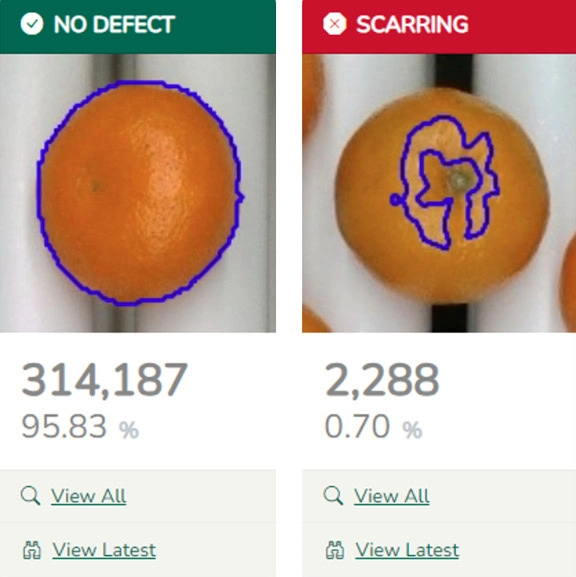
AI visual inspection is not one thing. On a real line it covers a handful of distinct jobs, and it helps to see them separately:
- Inline defect detection. Catching burns, cracks, discoloration, deformation and other cosmetic or structural defects as product moves, without pulling it off the line.
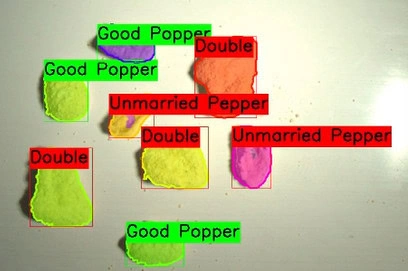
- Foreign-material detection. Spotting the thing that should not be there, a conveyor belt chip, a wooden fragment, a piece of stray plastic or packaging that does not belong in the mix.
- Completeness and assembly verification. Confirming that every component, topping, or element is present and correctly placed before the unit moves on.
- Vision-guided robotics. Giving a pick-and-place robot the ability to find and handle products that arrive in a random position or orientation, which is the norm with natural products.
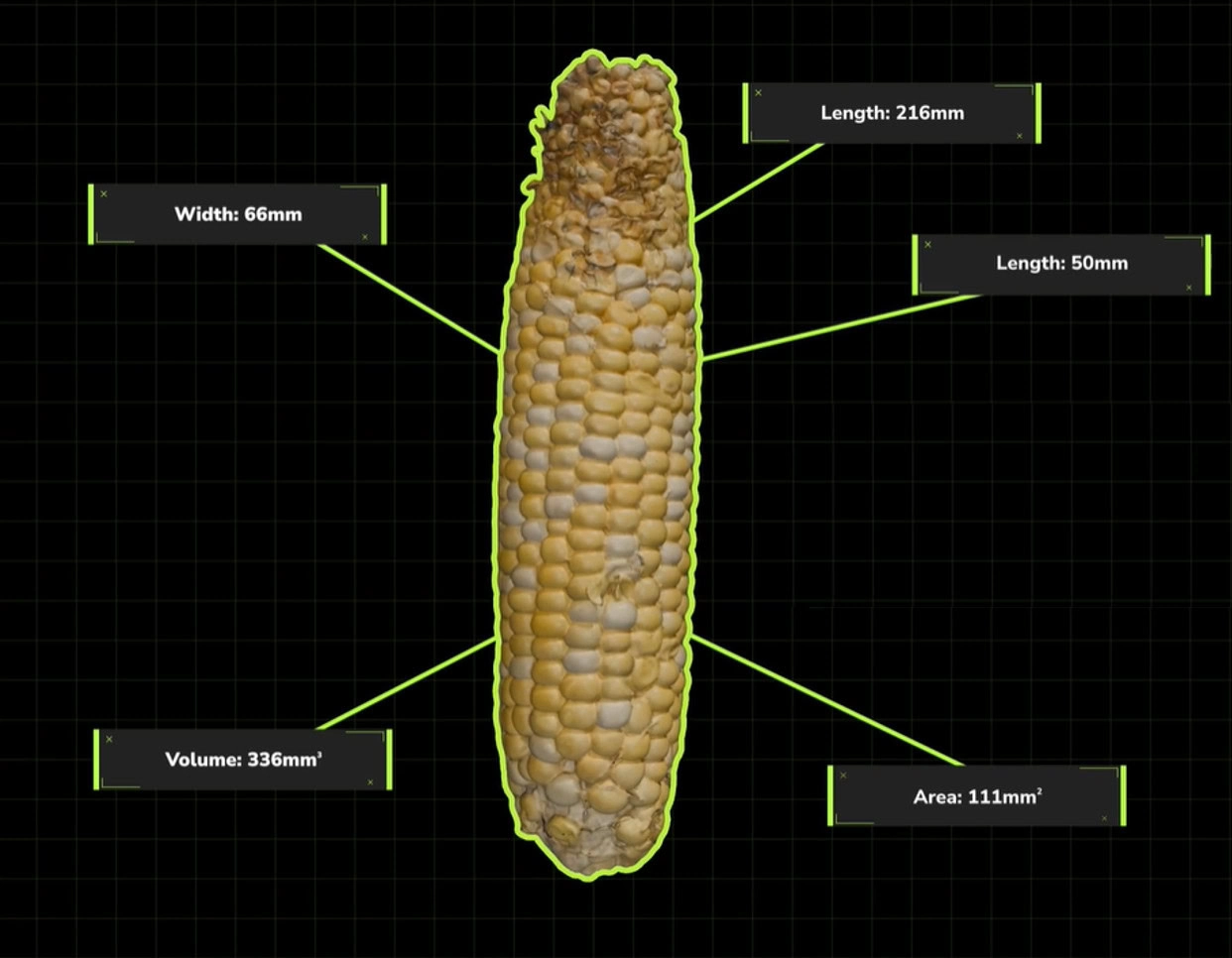
- Yield and throughput analytics. Turning what the camera sees into a record of what the line is doing, so quality trends and losses are visible instead of being guessed at.
Three of these are worth dwelling on. Foreign-material detection is the one food manufacturers can least afford to get wrong, and it is exactly the rare, irregular event that fixed rules struggle to specify in advance. Vision-guided picking is where inspection and robotics meet, and it is a large part of the practical value on a food line. Our page on vision-guided pick and place robotics goes into how the same object understanding that grades a defect also tells a robot where to grip. And the analytics matter because a defect caught is only half the win. The other half is learning from the pattern, which is what closes the loop between detection and process improvement.
AI quality control in food manufacturing
Food is where the argument for AI vision is easiest to make, because food is where variability is unavoidable. No two pizzas are topped identically. No two chicken fillets are the same shape. AI quality control on a food line has to judge a moving target: cheese coverage and topping count, burns and color, seal integrity, fill level, foreign material, all at production speed.
Take a few of those in turn. Cheese coverage and topping count are a classic variability problem. No fixed rule captures every acceptable arrangement, but a model trained on enough good and bad examples learns the line a person would draw. Seal and fill verification catches the leaker or the underfill before it ships, which is a food-safety problem and a giveaway problem at once. Foreign-material detection is the one nobody can afford to miss, and it is exactly the kind of rare, irregular event that fixed rules struggle to specify in advance. None of these is a measurement in the rules-based sense. Each is a judgment made at line speed, on product that never looks quite the same twice. That combination, high variability and high consequence, is where AI vision earns its keep and where rules-based tools run out of road.
This is also where the limits of manual inspection show. A landmark study of visual inspection reliability found that inspectors correctly rejected 85 percent of defective parts and, just as important, wrongly rejected 35 percent of good ones, against an industry-average catch rate of about 80 percent. That work looked at precision-manufactured parts rather than food, so treat the numbers as a general read on human inspection, not a food-line figure. The lesson still travels. People are inconsistent at sustained visual inspection; they tire, and both misses and false rejects cost money.
The food-line results Oxipital points to fit that pattern. In a frozen pizza deployment, an AI vision system inspecting pizzas and toppings through the plastic wrapping at end of line was stood up in a single day without disrupting production; the manufacturer projected six figures in annual savings by moving manual quality-control roles to the automated system. The consistent, checkable part is the deployment in a day and the shift away from manual inspection.
The real barrier to AI vision: data, labeling and expertise
Most guides stop at the capability and skip the reason projects stall. Here it is. Traditional AI vision has a cold-start problem. Before the model catches a single defect, someone has to collect thousands of images, label them and usually loop in a data-science team to build and tune the model. That is slow and expensive, and it is why so many promising pilots never reach the line.
The scale of it is not a small tax. IBM’s research puts data preparation at 60 to 80 percent of total AI project time. For a plant team, that is months of work before there is anything to show for it, on a task that is not their core job.
This is the problem Oxipital’s V-CORTX platform is built to remove. Its models are trained on proprietary synthetic data, so there is no image collection and no manual labeling to do before deployment. The application logic is built in a no-code Recipe Builder, so setting up or changing an inspection does not require a programmer. It retrofits existing lines and is designed to integrate with existing PLCs, robots and automation systems over standard industrial protocols. The effect is to turn a months-long data project into a deployment measured in days. The V-CORTX no-code AI machine vision platform page covers how the pieces fit together.
How to get started with AI vision on your line
You do not need a plant-wide program to begin, and you do not need to interrupt the one you already run. Oxipital’s systems retrofit an existing line and fit into the current workflow at the data-gathering stage, so a pilot runs alongside production rather than stopping it. A sensible path looks like this:
- Define the inspection task precisely. Name the defects that matter and the acceptance criteria a good inspector would use.
- Assess the line. Product presentation, speed, lighting and where a camera can physically see the unit.
- Pilot on one line. Pick the inspection with the clearest pain and the most measurable outcome.
- Measure against your current process. Run the system alongside manual inspection and compare catch rate and false rejects, using the human-inspection numbers above as a realistic baseline. Then scale what works.
The reason this path is faster than it used to be comes back to the data problem. When a system needs no image collection and no labeling, and when the logic is built without code, the pilot that once took months to even start can be running in days. That changes the calculus of trying it. If you want the longer form, our industrial AI vision whitepaper walks through the approach, and the food manufacturing case studies show it on real lines.
Talk to Oxipital about AI vision for your line
If inspection is a task still relying on a person’s eyes, it is worth seeing what vision would do with it. The first step is a conversation about your line, your product and the single inspection that would prove the most. Contact Us.
AI In Manufacturing Frequently Asked Questions
AI is used across manufacturing for quality inspection, defect and foreign-material detection, predictive maintenance, process optimization and vision-guided robotics. Of these, vision-based inspection tends to be the fastest to deploy and the easiest to prove, because it is a discrete task you can measure against your current process.
Traditional rules-based machine vision follows engineer-defined criteria and fixed thresholds, which makes it fast and reliable on stable parts but brittle when the product varies. AI vision learns what good and bad look like from examples, so it handles natural variability at line speed with far less hand-tuning.
AI visual inspection uses cameras and deep-learning models to check products on a production line, detecting defects, foreign material and assembly or completeness errors and making a pass or fail decision in real time.
It depends on the line and the current process, so it is more honest to talk in ranges than to promise a figure. As a baseline, manual visual inspection averages about an 80 percent catch rate, and it comes with false rejects too. AI vision targets more consistent results at full line speed, with the exact gain depending on your application.
Traditional AI vision projects can take months, mostly because of image collection and labeling. With synthetic training data and no-code setup that timeline shortens to days, and modern systems retrofit existing lines rather than replacing them.