
Food Safety Inspection Automation: A Complete Guide for Food & Beverage Manufacturers
How AI vision automates food safety inspection for visual defects, foreign material and label errors at line speed, and where it complements HACCP.
Key takeaways
- Food safety inspection automation uses AI vision to check visual defects, foreign material and pack or label errors on the line, at line speed.
- It reduces recall risk and improves detection. It does not prevent recalls or guarantee safety on its own.
- A camera cannot see a pathogen or measure a chemical residue, so those hazards still need lab testing and process controls.
- Automated food inspection is a complement to your HACCP plan, not a replacement for it.
- Modern systems retrofit existing lines and use pre-trained models, so a plant team can deploy in days rather than months.
Food safety inspection is where many food and beverage manufacturers feel the gap between what their program requires and what a manual line can deliver. Human inspectors are skilled, and they get tired. Product varies, shifts run long and the defects that matter most are often the ones a person catches least reliably at 3 a.m. Food safety inspection automation puts a camera and an AI model on the line to check every unit rather than a sample. Used well, it strengthens a HACCP plan instead of replacing it. The automated system watches for what a camera can see, and your existing controls handle the rest. This guide covers what automated inspection can and cannot do, what recalls actually cost, and how to deploy it on the lines you already run.
What automated visual inspection can (and cannot) do
Start with the honest scope, because that is what earns trust with a quality team. Automated visual inspection is a vision inspection system: one or more cameras, controlled lighting and an AI model trained to recognize a specific product and its defects. It reduces recall risk by checking problems consistently, on every unit. It improves detection of issues that are hard for a tired eye to hold to one standard. The real value is consistency. A model applies the same criteria to the first unit of the shift and the last, and it records every call it makes, so the data shows where a problem is trending before it becomes a rejected lot.
Here is what it does well. It flags visual defects such as char and misshape, or color and size that fall outside your spec. It detects foreign material that is visible on the surface, such as plastic, metal shards or stray packaging. It verifies pack and label accuracy, which matters because an undeclared allergen from a mislabeled pack is one of the most common reasons products get pulled.
Here is what it cannot do, and no honest vendor should claim otherwise. A camera cannot see a pathogen such as Salmonella or Listeria. It cannot measure a chemical residue. It does not prevent recalls, eliminate every defect or guarantee that a shipment is safe. Those hazards need microbiological testing, chemical analysis and the process controls in your food safety plan. Automated food inspection is one layer that makes the visible failures far less likely to reach a customer. It works alongside the rest of your program.
The cost of getting it wrong
Recalls are expensive long before you count lost sales and brand damage. A widely cited industry study from the Grocery Manufacturers Association and FMI, reported by Food Safety Magazine, put the average direct cost of a food recall at roughly 10 million dollars. That figure is dated, so treat it as an order of magnitude rather than a current price. Direct costs include product retrieval and disposal, plus investigation and regulatory response. The indirect costs, from stalled shipments to lost shelf space, often run higher.
The volume is not small. The FDA recalls database and the USDA FSIS recalls list, which covers meat and poultry, together show hundreds of food recalls in a typical year. Across both agencies, undeclared allergens and mislabeling sit among the most common causes, closely followed by foreign material contamination. Those are exactly the failure modes a vision inspection system is built to catch.
A recall also travels. Once a lot leaves the plant, tracing it back through distribution is slow and public, and retailers remember which suppliers cost them shelf space. Catching a defect on the line, before it ships, keeps a quality problem inside your four walls where it is cheaper to fix.
This is where the labor math starts to matter. Manual inspection is hard to staff and harder to keep consistent across shifts, and the cost of a single escape can dwarf a year of inspection labor. Manufacturers looking to reduce labor with food inspection automation are usually solving two problems at once: the people they cannot hire, and the defects those open roles let slip through.
How to deploy on existing lines
The old objection to machine vision was that it took a data science team and a mountain of labeled images to train a model, then months of integration. That is the part automation has changed.
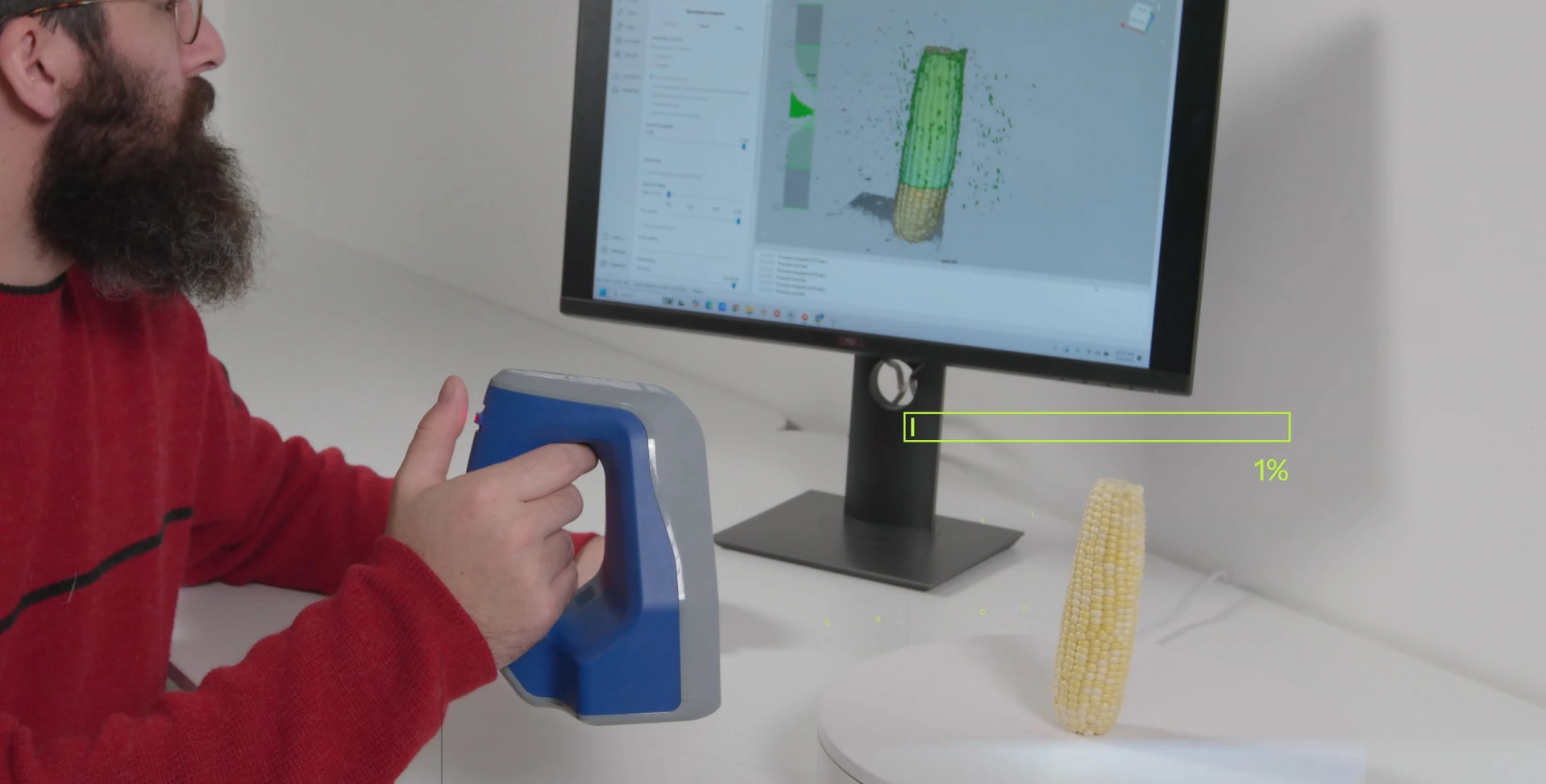
A modern visual AI inspection systems approach retrofits your existing line instead of rebuilding it. The camera and lighting mount over the conveyor you already run, and the software connects to your reject and control logic. Oxipital AI builds this on the V-CORTX platform, which pairs pre-trained object models with a proprietary synthetic data generation pipeline. In plain terms, the model learns your product from generated data instead of thousands of photos you have to collect and label. There is no annotation step and no code to write. That generated data is not invented by generative AI. It is built from a high-resolution 3D scan of your actual product, which captures its real shape, color, and natural variation and is what enables the synthetic data generation.
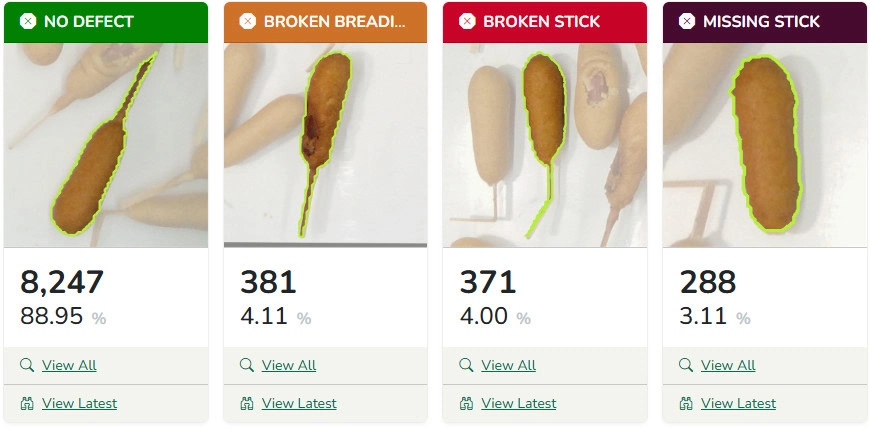
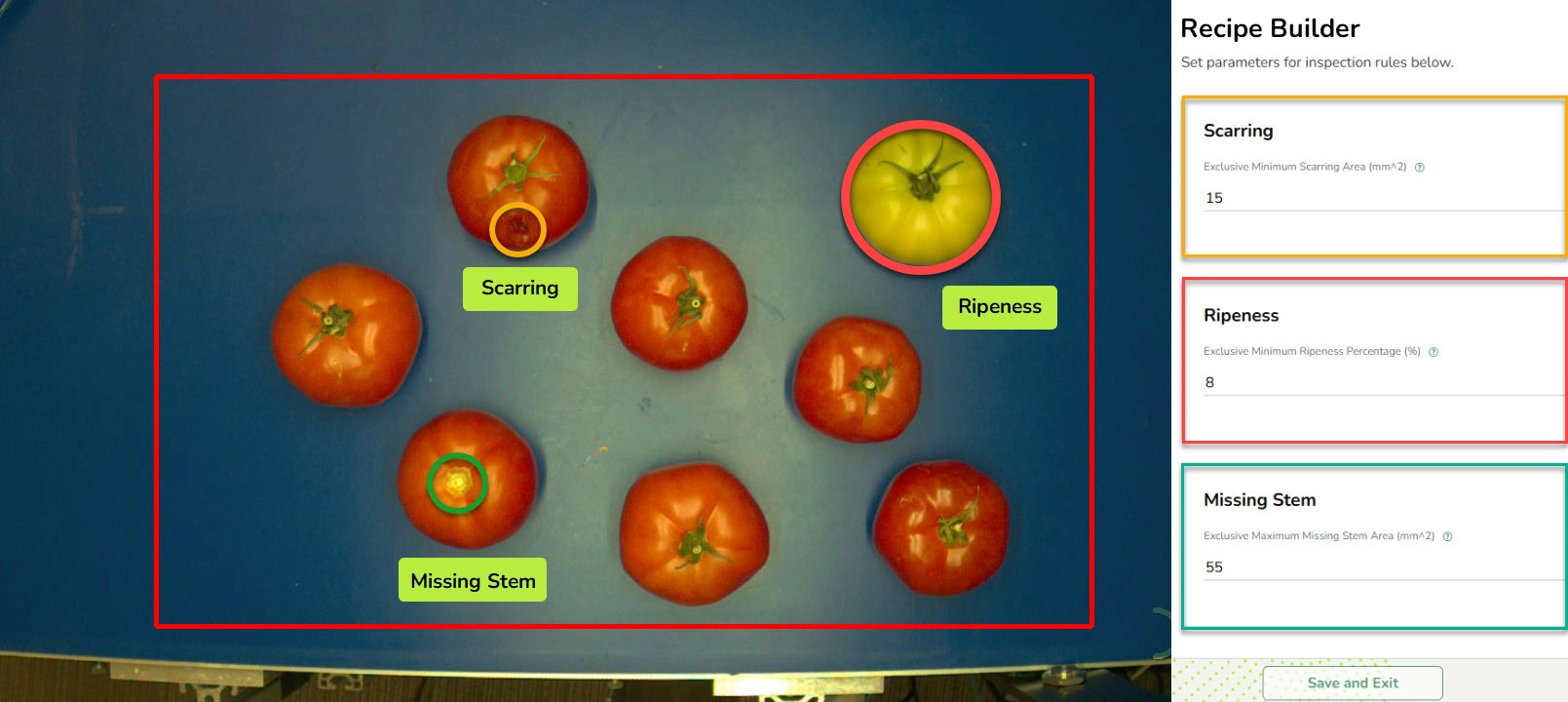
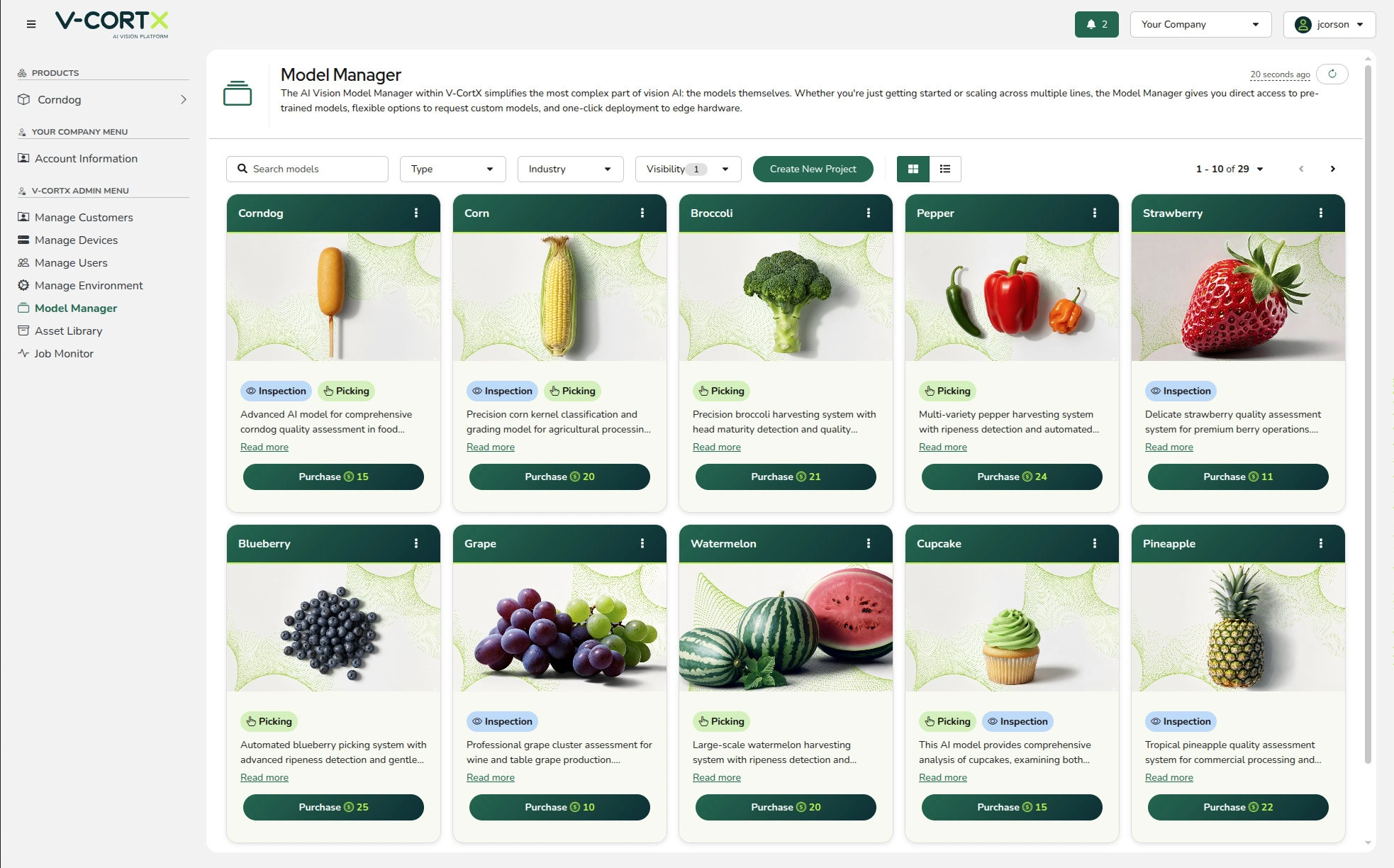
Inside the platform, the AI Vision Model Manager holds the pre-trained models. The Recipe Builder lets a line lead set inspection rules in human-readable terms, and the Analytics Dashboard turns each inspection into data your team can act on. Oxipital AI works with OEMs and system integrators, and it offers no-obligation technology trials, so you can prove the system on your own product before committing to a rollout.
That is why deployment is measured in days rather than months. For products with real shape and color variation, such as produce, poultry and frozen items, automated food inspection with 3D vision adds depth data that flat RGB cameras miss, which improves detection of misshape and surface defects. The inspection runs on OX2 inspection hardware built in food-grade, IP69K enclosures, so it holds up to washdown and the harsh conditions on a real production floor. The result is a system your plant team can run, not a research project you have to maintain.
Building the program
Building an inspection program is mostly about drawing a clean line between what a camera should own and what stays with people and the lab. A simple split keeps the plan honest.
Automate with visual inspection:
- Visual defects such as char, misshape or off-spec color and size.
- Foreign material that is visible on the product surface.
- Pack and label verification, including allergen-relevant labeling.
- Orientation and final presentation, so each piece faces the right way and the finished pack looks right to the customer.
- Fill level, count and basic assembly checks.
Keep with people, the lab and process controls:
- Pathogen testing for organisms like Salmonella and Listeria.
- Chemical and residue analysis.
- Environmental monitoring and sanitation verification.
- HACCP critical control points and the judgment calls around them.
The pattern is consistent across plants. Let the vision inspection system handle the high-volume, repetitive checks where consistency beats human stamina, and reserve your specialists for the hazards that require a test, a culture or a decision. Documenting that division early, inside your existing food safety plan, is what turns a camera on a conveyor into a real food safety automation program.
The payoff compounds over time. Every inspection is a data point, and over weeks that record tells you which defect is rising, which line runs hot and which supplier lot arrives with the most trouble. That turns inspection from a simple pass or fail gate into a feedback loop that improves the process upstream.
Frequently asked questions
No. Automated inspection reduces recall risk and improves detection of visual defects, foreign material and pack or label errors, but it does not prevent recalls on its own. Pathogens and chemical hazards need lab testing and process controls.
Foreign material, visible defects and pack or label verification, at line speed. In practice that means surface contaminants, product that falls outside your quality spec and packaging that does not match the product inside. It does not read pathogens or chemistry.
No. It complements HACCP, lab testing and process controls. Visual inspection covers what a camera can see on the line, while your lab still owns pathogens, chemistry and environmental monitoring.
Oxipital AI states days rather than months, because the pre-trained models retrofit existing lines without a labeling or coding step. Actual timing depends on your product and line, so the honest answer is to ask for a trial on your own product and watch it run.
Put it to work on your product
The fastest way to judge food safety inspection automation is to point it at the product you actually run. See Oxipital AI’s visual AI inspection systems for food lines, and for the detail on how the models and no-code workflow fit together, explore the V-CORTX platform. Bring your hardest defect. A trial on your own line will tell you more than any number on a page.