
USDA’s New Food Plant Line Speed Rules: How AI Vision Can Help Plants Prepare
With the USDA proposing higher line speeds for poultry and swine, food manufacturers need inspection systems that can keep up without compromising safety or quality. Learn how AI machine vision helps plants maintain consistent inspection at higher speeds while detecting defects, foreign objects, and other quality issues in real time.
Are you ready for faster line speeds?
The food industry is rapidly changing as innovations in automation are starting to impact the food market. As the world has pressed ahead with faster line speeds, advanced machine vision, and high speed automation, food has always lagged. With recent advances in machine vision and machine learning, the food market is finally catching up.
Key Takeaways
- The USDA FSIS has proposed raising maximum line speeds for young chicken, turkey, and swine establishments.
- Faster line speeds create new bottlenecks, safety risks, and quality-control pressure on the plant floor.
- Food manufacturers have three ways to adapt: hire more workers, retrain existing workers, or equip them with better tools.
- AI machine vision lets existing teams keep pace, inspecting for defects, foreign objects, trim, and final pack at speed.
- V-CORTX uses pre-trained object models and proprietary synthetic data generation to deploy fast and hold accuracy as conditions change.
Legislation Changes
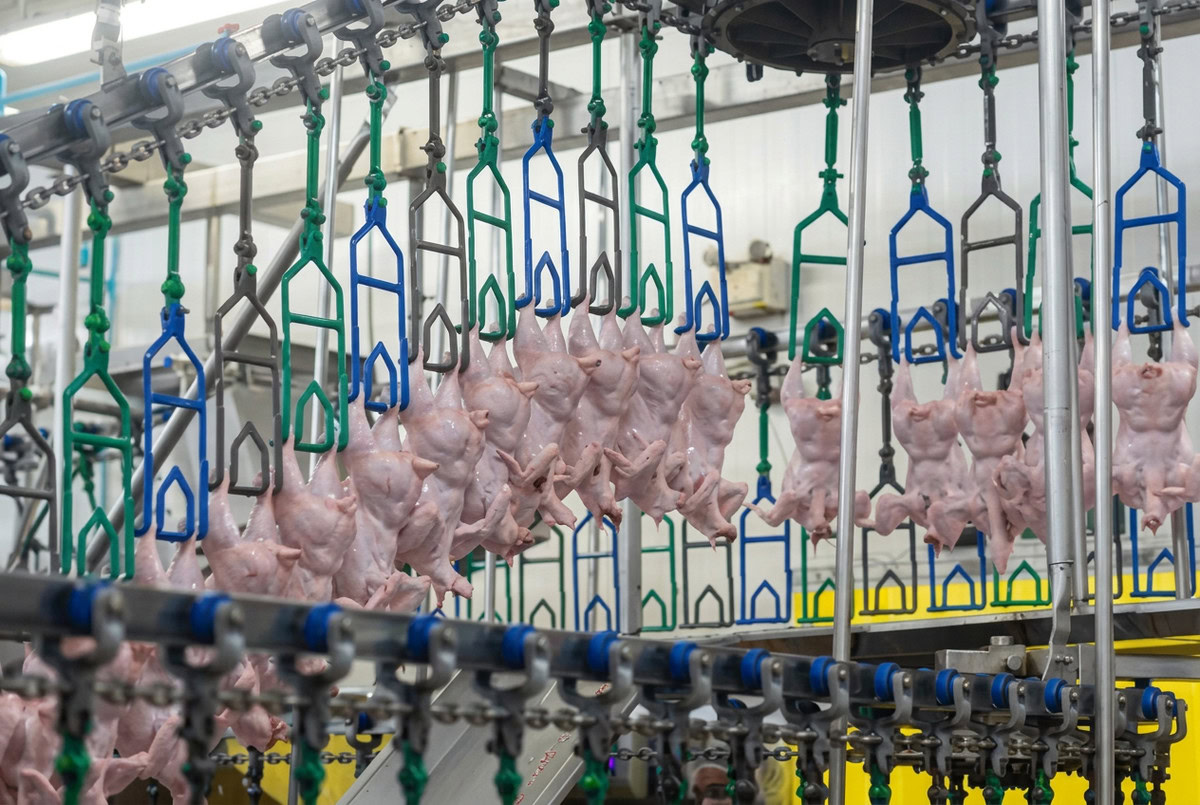
The FSIS (Food Safety and Inspection Service), part of the USDA, is proposing amendments to existing regulations to increase the maximum number of animals that can be processed per minute. This change is based on the type of animal with small birds, medium birds, and swine all seeing a notable increase in the maximum number of animals processed.
| Current Rate | New Rate | |
| Small Bird | 140 Birds / Minute | 175 Birds / Minute |
| Medium Bird | 55 Birds / Minute | 60 Birds / Minute |
| Swine | 1106 Hogs / Hour | Based on Individual Process Control |
Impact from Changes
With faster line speed, hiccups are bound to occur and it’s important to know how to move quickly to fix these issues.
Risk Assessment
It’s smart to assess risk beforehand and have plans to mitigate issues that are likely to occur, but there are often unforeseen issues that crop up that can be costly if not dealt with. With increased speeds, new bottlenecks can crop up that didn’t exist before. Are the cutting machines tuned properly to keep up with the new speeds? Can your existing employees keep up with the new speed? It’s impossible to know the severity of all these possible issues until you deploy the line and see what’s happening.
Fast Line Speed vs Safety
With traditional automation, a bad product slipping through the cracks can cause the company money but is often addressable with a return and replacement. In the food space, bad products getting out can cause people to get very ill. It is more than just a product but a requirement to sustain life. As line speeds increase, it’s important to maintain safety to ensure the customers remain safe. This will require more effort per minute to keep up with the increased line speed rates.
Three Options to Adapt
To prepare for these upcoming changes there are only three options food manufacturers have. Hire more employees, train existing employees, or empower the existing employees with more powerful tools.
Train Existing Employees
Existing employees have been trained to do their job at a certain speed. Increasing the line speed could simply mean retraining employees to do it faster. The issue here is that poultry plants and slaughterhouses are struggling to find human labor as it is. The protein space is extremely dependent on margins and with increased training employees will likely demand increased wages. This would make it even more difficult to find human labor.
Hire More Employees
Instead of training existing employees to do their job more efficiently, another solution would be to throw more bodies at the problem. The issue here is that space is extremely limited in food manufacturing environments and was built with space for the existing number of line workers. Adding more could decrease efficiency due to everyone getting in each other’s way. Even if there was more space, as stated before, it’s already challenging to meet labor needs.
Empower Employees with Tools
Throughout human history, most innovations haven’t been by people just working harder, but being equipped with a tool to make the job easier. The wheel, the hoe, and the knife are all examples of tools that made tasks easier. The wheel enabled transportation, the hoe enabled farming and the knife enabled cooking and skinning. When it comes to automation, machine vision is the tool that can make everyone’s lives easier.
Machine Vision Food Capabilities
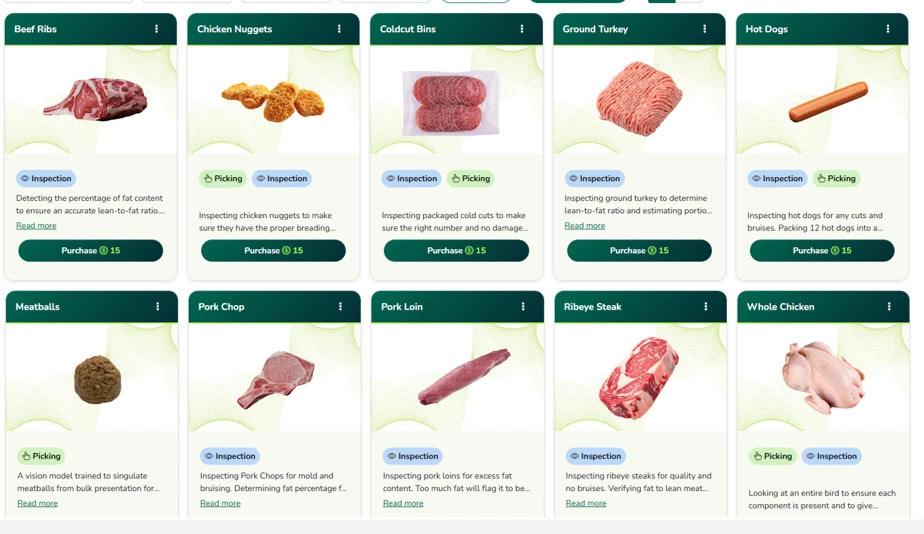
While traditional machine vision has struggled in the food space, AI enabled vision has changed the game in the food space. Object models can be prebuilt to solve very specific problems.
Robotic Guidance
Rates are always being pushed, and hitting higher belt speeds increases profits. Optimize each robot with a customer pick strategy to achieve the highest rates.
Delicate Handling
Food can be crushed or bruised if not handled with care. Gripping a chicken correctly requires enough force so it doesn’t drop, but not too much that it is crushed.
Foreign Object Detection
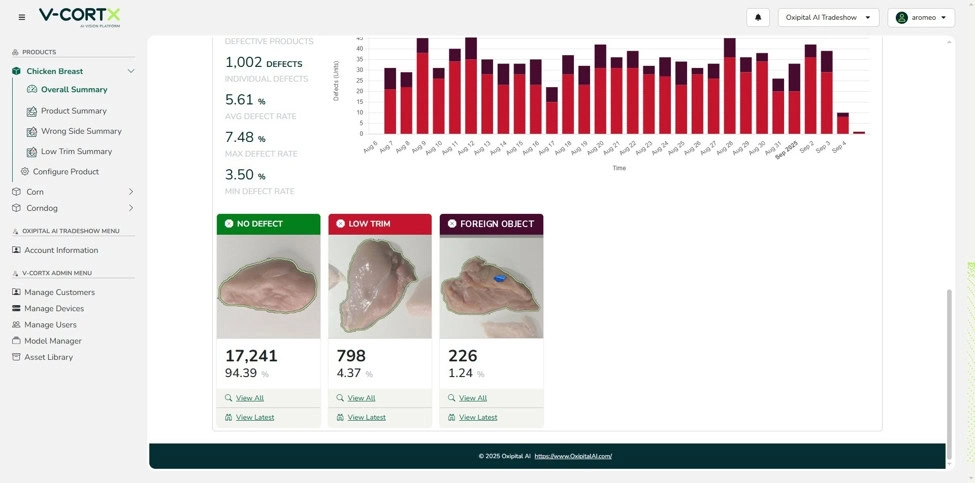
Blue plastics, wood chips, and cardboard pieces are common “foreign objects” that shouldn’t be present in food. Identify these defects and remove them ensuring pristine quality.
Trim Level
Identify the percentage of fat relative to the entire cut to determine if it should be categorized as high or low trim. Eliminate human error and reduce giveaway.
Final Pack
Consumers choose the more aesthetically pleasing product when prices are similar. Check each chicken breast has the membrane side up and is sitting snug between alternating breasts.
Defect Film Strip
HMIs can show a live view film strip of the last inspected images and a defect detection warning. V-CORTX takes inspection further, stopping a machine when a defect is detected and providing a detailed image of exactly where it is located. This ensures no defects get through while also maintaining high uptime on machines, keeping food safe, and maintaining the rate.
What does a Plant Need to Succeed? V-CORTX!
While automation isn’t anything new, it can be very new to the food industry. To ensure automation projects go smoothly it’s important to have eyes on the final pack out. This enables a plant to diagnose the problem at the root cause and address it as needed.
Pretrained Object Model
Every solution comes with a functioning vision model that is ready out of the box to handle organic variation that is found in all food and is designed to easily adapt to any changes in the production environment.
Unlike other machine vision solutions, V-CORTX uses an innovative training method to quickly develop extremely accurate vision models. The basis of the model is a 3D scan of your actual product, not production images. This scan combines the 3D data and the RGB color image to generate a comprehensive 3D asset that captures organic variability and enables powerful defect segmentation.
Following the 3D scan, V-CORTX further trains the object model using synthetic data generation. Instead of following the error-prone process of labeling 2D images to identify all instances of product, we use a physics engine to generate a scene that contains the desired amount of product across millions of permutations. Many vision systems falter when faced with real production environments. V-CORTX does not lose accuracy even with lighting changes, conveyor retrofits, and new defects, because synthetic data generation can simulate any variation in conditions to train the model.
Fit into the Food Space
V-CORTX™ enables food manufacturers and machine builders to deploy vision quicker than ever before by combining 2D and 3D vision. Our camera systems are packaged in food-grade IP69K, easy-to-clean enclosures that are perfect for food processing applications. The small form factor is designed to slot into existing workspaces, built for human inspection. Ethernet communication makes it easy to interface with any PLC or robotic system.
Ability to Control
Equip your team with the ability to maintain desired rates by easily adjusting what product counts as a defect and optimizing the order in which robots pick products. You control how much of a particular defect classifies it as a bad product, including when multiple factors together create a defect. For example, a chicken product may be considered defective if it has both too much fat plus blood marks. Recipe Builder allows you to define the defect as a specific fat percentage or blood mark size.
See how V-CORTX helps food plants keep up with faster line speeds, or contact our team to set up a no-obligation technology trial
Sources
• USDA FSIS: Maximum Line Speed Rates for Young Chicken
• USDA FSIS: Maximum Line Speed Under the New Swine Inspection System
• Federal Register: Maximum Line Speed Rates for Young Chicken and Turkey
• National Chicken Council: comments supporting the USDA proposal
• Food Safety Magazine: FSIS proposes to raise line speed limits
FAQ
Here are a few answers to get started.
Can’t find your question?
Send us an email — we’ll get back to you with an answer ASAP.
What is the USDA’s new line speed rule?
The USDA’s Food Safety and Inspection Service (FSIS) has proposed increasing the maximum number of animals processed per minute, with notable increases for small birds, medium birds, and swine.
Will faster line speeds make food less safe?
Not necessarily. Faster line speeds raise the stakes for inspection, which is why many plants are adding AI machine vision to maintain safety and quality at higher rates.
How does machine vision help with faster line speeds?
AI vision inspects every product for defects, foreign objects, trim level, and correct final pack in real time, so existing teams can keep up without sacrificing quality.
What makes V-CORTX different from traditional machine vision?
V-CORTX uses pre-trained object models built from 3D scans and proprietary synthetic data generation, so it deploys in days and holds accuracy through lighting changes, conveyor retrofits, and new defects.