
Vision Guided Robotics: AI Picking at Scale
How AI vision makes vision guided robotics reliable at line speed on variable product, retrofits the line you already run and proves out on a trial.
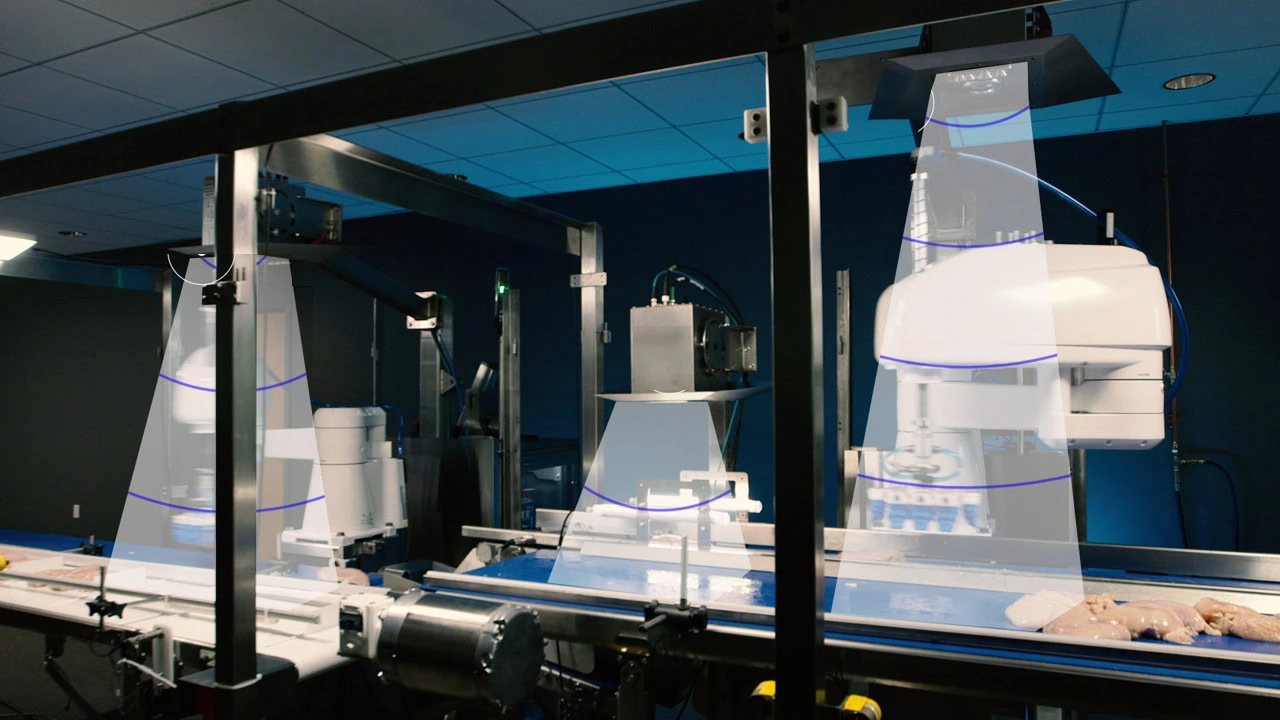
Key takeaways
- Vision guided robotics lets a robot find and pick real product by sight, instead of assuming every piece sits in the same place.
- Traditional rule-based vision struggles when product varies, when lines run wet, and when glare shifts through the shift.
- AI vision handles that variation using pre-trained object models and proprietary synthetic data generation, so there is no per-part labeling and no data-science project to start.
- Oxipital AI provides the vision. Partners provide the robots and grippers, integrated into one working cell.
- Before you buy, test the system on your own product and confirm it retrofits the line you already run.
Picking real product is harder than a demo makes it look. A frozen pizza is never quite the same pizza twice. Poultry flexes and sticks. Produce arrives in every size the field grew. Add a wet conveyor, a moving line and overhead lights that change through the day, and the neat assumptions behind a fixed pick-and-place start to fall apart. This is the problem vision guided robotics set out to solve: a robot that locates each item by sight and picks it where it actually is, not where a program hoped it would be. The question for a plant is not whether the idea works. It is whether it stays reliable at line speed, on your product, day after day.
Where traditional vision-guided robotics breaks

Classic machine vision is rule-based. An engineer defines what the part looks like: its edges, its color, its position within a tolerance. On a clean line running one rigid part, that works well and runs fast. The trouble starts when the product refuses to hold still or hold shape.
Natural product varies. Two chicken thighs are different shapes. Two heads of lettuce are different sizes. A rule tuned to one example misreads the next, so the robot misses the pick or grabs the wrong spot. Wet surfaces throw glare that a rules-based system reads as an edge that is not there. And every changeover to a new product, or even a new supplier of the same product, can mean re-teaching the vision by hand.
That re-teaching is the hidden cost. A capable integrator can make a rules-based cell work for a single, stable SKU. Keeping it working across seasonal produce, mixed pack formats and frequent changeovers is a different job, and it is where many vision projects stall. The cell that ran perfectly in the acceptance test starts throwing misses the week a new product ramps up. Operators compensate by slowing the line or picking by hand, which quietly erases the gain that justified the automation. The robot is fine. The perception is the bottleneck.
How AI vision fixes it
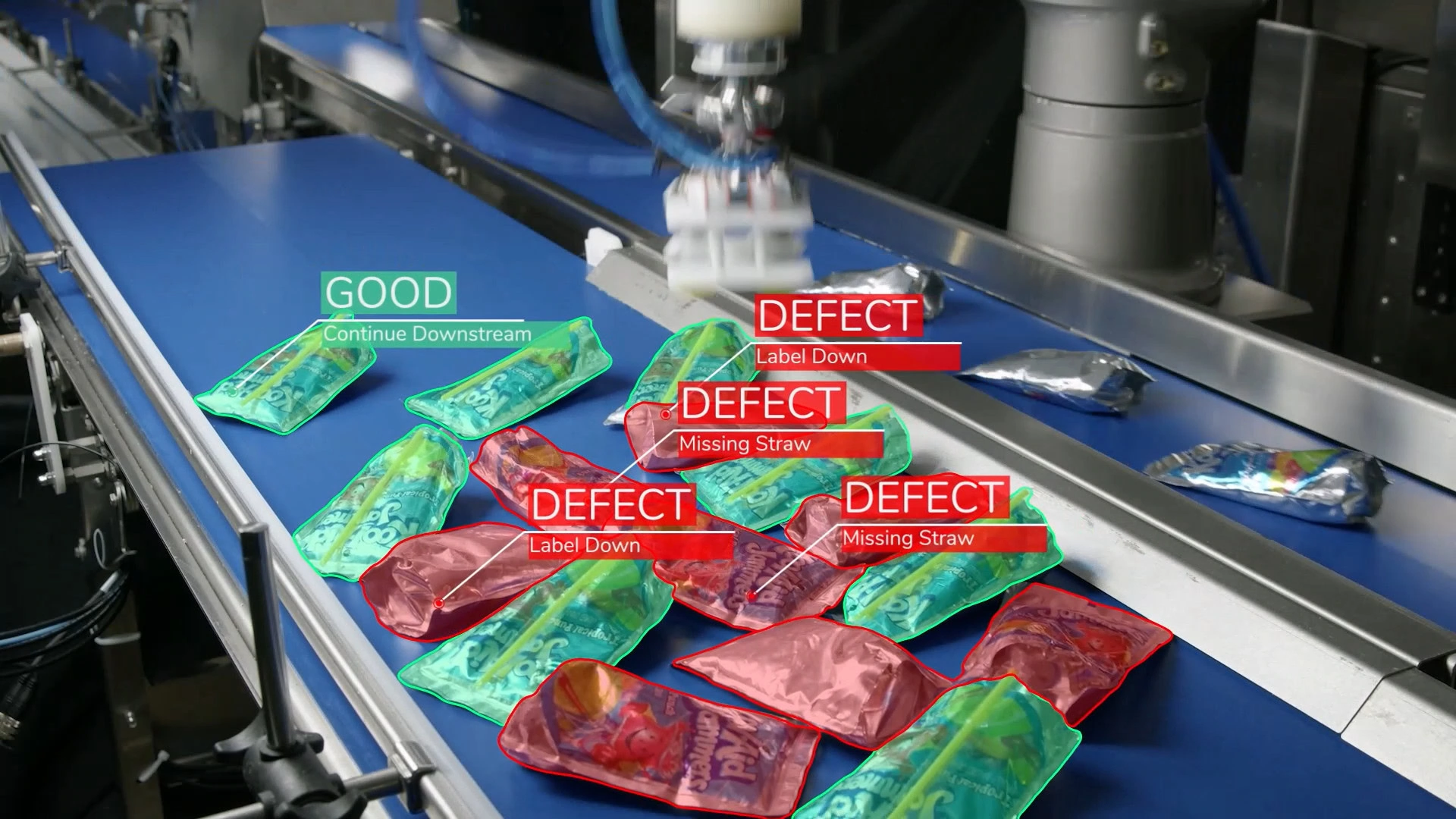
AI vision changes what the robot works from. Instead of hand-coded rules for one part, it uses pre-trained object models that recognize a class of product across its natural variation. Show it a thousand slightly different chicken thighs and it still knows a chicken thigh. That is the shift: the model learns the product, not one photo of it. The V-CORTX platform is where Oxipital AI builds and runs those models for food and consumer-goods lines.
The models are built without collecting and labeling your images. Oxipital uses proprietary synthetic data generation to create the training data, so you skip the months-long image-gathering exercise that usually comes before a line can see. There is no code, no DIY and no machine learning expertise required to deploy, and the rules a plant team does set are human-readable. Most lines can be inspecting or guiding a pick in days, not months. The training data comes from a high-resolution 3D scan of your actual product rather than traditional 2D image labeling, so the model learns real shape, color, and variation, and that scan is what enables the synthetic data generation.
It also reads the scene in two ways. V-CORTX works from 3D Vision and RGB inputs, so it understands both the shape of an item and its surface. That combination is what lets it locate a soft, shiny, irregular piece of food and hand a robot a pick point it can trust. A rules-based system reads pixels; an AI model reads the product. When product or packaging changes, you update the model in the AI Vision Model Manager rather than rewriting rules from scratch. That is the difference between a changeover that takes an afternoon and one that pulls an engineer off the floor for a week.
The same approach carries into machine vision inspection. On the same line, the system flags visual defects, foreign material and pack or label errors, and it records every one. Catching those consistently reduces recall risk. It does not prevent recalls on its own, and pathogens or chemical hazards still need the controls you already run.
Vision, gripper and robot as a system
A pick only works when three things agree: the vision that finds the item, the gripper that holds it and the arm that moves it. Oxipital AI provides the vision. It does not build the robot or the gripper. Instead it integrates with partners who do, through its Preferred Partner Program.
Two current partners show how that fits together. EnSight Solutions pairs Oxipital vision with its Smart Styler automated picking system, which runs on a Staubli robot; the Smart Styler and the robot belong to EnSight and Staubli, not to Oxipital. Schmalz brings its mGrip finger grippers and vacuum end-of-arm tooling for handling delicate and irregular food, and the mGrip is Schmalz tooling. Convergix, the third current partner, brings end-to-end automation integration. In each case the vision is the part Oxipital owns, and the partner supplies the hardware that acts on what the vision sees.
That division matters for robotic picking at scale. Food is a hard thing to grip. A part that is wet, soft or oddly shaped needs tooling designed for it, and a vacuum cup sized for a rigid box will drop a chicken breast. You get perception built for variable food and grippers built for the same product, chosen for the job rather than forced to fit. Oxipital’s visual AI inspection systems are designed to retrofit existing processes and equipment, so the cell can go onto a line you already run instead of replacing it. The inspection hardware itself, OX2 inspection hardware, uses food-grade, IP69K enclosures with integrated cameras, Edge-AI computers and application-specific lighting, built for the wash-down environments food lines actually run in.
What to check before you buy
Vendor claims sound alike until you test them on your product. A short, concrete checklist keeps the evaluation honest.
- How does it handle product variation? Ask to see it pick or inspect your hardest SKU, not a clean sample. Natural variation, glare and changeover are where rules-based systems fail, so that is where the AI approach has to prove itself.
- Will it retrofit the line you run today? Oxipital states its solutions retrofit existing processes and equipment, so ask exactly what changes on your line and what stays the same.
- Can you run a trial on your own product? Insist on a no-obligation technology trial with your product, your lighting and your line speed. A number in a brochure is worth less than one clean run on the thing you actually make.
- Who owns each part of the cell? Vision, gripper and robot may come from different companies. Know which vendor is responsible for what before you sign.
For a wider view of where the field is heading, industry bodies such as A3 (Association for Advancing Automation) bring vendors and integrators together across robotics and machine vision. You can read more about Oxipital’s own approach and partners on its about Oxipital AI page.
Frequently asked questions
Vision guided robotics is a robot that uses a camera and AI perception to locate and pick objects, rather than relying on fixed positions. The vision finds each item where it actually sits, then tells the robot where to pick.
AI generalizes across natural product variation without hand-coded rules or per-part labeling. One model recognizes a class of product in all its shapes and sizes, so the line keeps running through changeovers that would stall a rules-based system.
No. Oxipital provides the vision. Partners such as EnSight and Schmalz provide the robots and grippers, integrated with Oxipital vision as one cell.
Oxipital states its solutions retrofit existing processes and equipment, so a cell can go onto a line you already run. Confirm the specifics for your own line during a trial.
See it on your own product
You do not buy AI vision. You buy reliable picks, higher yield and fewer line stoppages on real product. The way to know whether vision guided robotics delivers that is to see it work, then run it yourself.
See how the V-CORTX platform powers vision-guided picking, then talk to Oxipital about an integrator or OEM trial through its visual AI inspection systems. Bring your hardest product. That is the test that matters.